Showing posts sorted by relevance for query nursery. Sort by date Show all posts

Sunday, October 31, 2021

Small Nursery Feature - Plant Life Nursery


I like to occasionally profile small nurseries that sell native plants. This week is one that isn’t all native plants, but it has been significantly increasing its native stock over the last few years. Plant Life Nursery is located in Rome, GA where it has attracted a customer following from not just Georgia but from many other southeastern states. 

Larry Spencer first started growing plants as a way to have fresh herbs for his job as a chef, but he also sold some of them part time. He eventually left that job to grow plants full time and started his landscaping and nursery business. He expanded to grow perennials such as purple coneflower (Echinacea purpurea) and Japanese maples, honing his skills with both natural talent and advice from experienced friends. American beautyberry (Callicarpa americana) was one of his early favorite native shrubs, recommended by a customer as many of his plants have been, and it’s still a big seller at the nursery (especially this time of year). 

One of this nursery’s strongest qualities is a wide variety of seed-grown plants. Larry and his nursery manager Ryan Lovvorn grow thousands of plants from local seed, all of them pesticide-free. These guys are incredibly talented in growing healthy plants. While many of these go on to become gallon-size perennials, shrubs, and trees sold to retail customers, an increasing part of the business is selling well-rooted plug trays to other small businesses. The seemingly endless rows of seedlings and plugs at the nursery in spring is an amazing sight. 


Larry’s passion for native plants as a bigger part of the nursery’s selection grew out of customer suggestions, some of them bringing local seed from their own gardens, as well as a deep sense of the environmental importance of supporting local ecosystems. Follow Plant Life Nursery on Facebook and Instagram to see a parade of monarch butterflies visiting the nursery and using its vast stock of milkweed plants to create the next generation. The list of native plants that they carry is longer every year and he says that sales of native plants now make up most of his business. 

Monarch butterflies grown at PLN

I’ve been recommending this nursery for years, but it’s the quality of the plants and the service that ensures they have many repeat customers. Larry and Ryan are friendly and helpful for customers who know what they want as well as those needing ideas. They have cultivated a wide selection of pollinator garden and bird-friendly plants for those looking to support wildlife. The nursery also supports numerous local groups with donations of native plants to community gardens as well as local master gardeners at the annual Chiaha Harvest Fair and the Georgia Native Plant Society. 

The nursery is open year-round, 7 days a week. Stop by sometime … but make sure you have plenty of room in the car for plants because you’ll need it.

Sunday, June 21, 2020

Small Nursery Feature – Night Song Native Plant Nursery


I like to occasionally profile small nurseries that sell native plants. This week is a relatively new one—it was started in 2014—and it has been steadily increasing its selection of plants. Night Song Native Plant Nursery is located in Canton, GA in a fairly rural area with lots of room to grow.

Katy Ross started the nursery after returning to Georgia from Arizona where she was inspired by their native plant ordinances. She previously worked for other nurseries, and always planned to have her own one day. A love of being outdoors and a childhood of listening to the night songs of cicadas, tree frogs, owls, and other creatures were her inspirations. Reading Doug Tallamy’s book solidified that it would be a native plant nursery. Habitat is more than what we see when we look at plants for beauty alone; without native plants, we might not have the critters that make magical night songs.

Night Song is actually my closest native nursery and I have enjoyed visiting it in Canton since the beginning. It has really grown a lot as they added more types of plants and more growing space. I like that it is both a production and a retail nursery. In browsing what is for sale, you walk past what is sprouting from seed.  Under a large canopy, you might see people potting up plants to the next size.

Two of the sun and shade hoop houses
Pots with natives help display them


I also enjoy stopping by the large pollinator garden next to the growing area. A collection of sun-loving plants bloom there throughout the seasons, showing customers what to expect of these plants and giving ideas on how to combine them. Butterflies, bees, and other pollinators are there in abundance. Katy feels that pollinator plants are their specialty. She enjoys growing plants from seed—some of it as local as her own garden—and using organic practices to stock unique and healthy plants for North Georgia gardens. They carry species plants and some cultivars, helping both gardeners and folks involved in restoration find the plants they seek. This year, one of the things I got was some seed-grown sneezeweed (Helenium autumnale) for the front bed that I updated at my house.

One view of the pollinator garden 

Seasonal stars pop up in the pollinator garden

Today the nursery carries a variety of perennials, ferns, shrubs, trees, and vines. They enjoy stocking native edible plants and might be one of the few places you can find mulberry (Morus rubra), black chokeberry (Aronia melanocarpa), and paw paw (Asimina triloba). Last year I teamed up with Katy on a talk about native edibles and the plants she brought to sell flew out the door.

In addition to selling plants, Katy and the nursery staff help to provide educational opportunities. Katy gives local talks, they’ve implemented seasonal programs like Bee Happy Hour (one is coming up next week), nature camp, plus spring and fall festivals to get people closer to nature. One year they had a paw paw festival and served tastings (they have a natural paw paw grove on the property). Get on their mailing list and follow them on Facebook to keep up with what’s going on at the nursery.

For other nursery profiles or to find specific topics on this blog, use the small search box in the upper left corner of the desktop version of the blog page.

Sunday, July 18, 2021

Small Nursery Feature – Stolen Flowers Nursery

I like to occasionally profile small nurseries that sell native plants. This week is a relatively new one, having been open just a few years in Armuchee in NW Georgia (near Rome). I recently had a chance to visit this nursery and was very impressed with the quality and diversity of plants.

I first met Terri Todd last spring when she approached the Georgia Native Plant Society about donating some extra plants, particularly purple coneflowers (Echinacea purpurea), to our sale. Unfortunately we canceled our sale for 2020 but she renewed the offer in 2021, so several of us drove there to pick up her donations. All of her plants are seed-grown and raised under the canopy of large open hoop houses on site. When I saw how beautiful and healthy the plants are, I knew I wanted to let other people know about this nursery.

The coneflowers she donated to GNPS

Terri has grown flowers for some time but initially focused on growing and selling cut flowers. She became interested in native plants after reading an article about the decline in Monarch butterfly populations. She said that she “was thrilled to find flowers with a purpose and function.” She now grows at least two species of milkweed (Asclepias sp.) to help those butterflies as well as a wide assortment of native wildflowers.

The name of the nursery was very interesting to me. She said the name was taken from an experience when she was a child. She would pass through a yard with a lot of flowers as she walked to visit her grandmother. She would pick some of the flowers to take to her grandmother. The owners of the yard, Miss Love and her sister, were not happy. “I don’t recall if I knew then that it was wrong to steal the flowers, but I found out for sure that it was very wrong when Miss Love called my mother to complain about me picking her flowers.”

Terri really enjoys growing flowers from seed, watching the plants grow and develop is part of the enjoyment. That tells me that she is in this for the love of plants, and we could see how much she cared about growing a diverse and healthy selection of mostly native perennials. She is planning to add some native small trees, shrubs, and vines in 2022. Perennials are available in 4.5 inch and 1G-sized pots.

I appreciate good signage!

Her nursery is open during the growing season: April-June and September through mid-November. The hours are Thursday-Sunday, 10 am to 4 pm. The best source of information is the nursery’s Facebook page. You can find the address and phone number there. I will give a tip on traveling there: when coming from Rome via US 27, if your navigation has you turn onto South Little Sand Mountain Road; make sure you stay on the road for about 4-5 miles until you get to the 4 way stop with North Little Sand Mountain and Little Sand Mountain Roads. The nursery is 1777 Little Sand Mountain Rd, Armuchee, GA in Chattooga County. Cell reception can be spotty in the area.

For other nursery profiles or to find specific topics on this blog, use the small search box in the upper left corner of the desktop version of the blog page.


Happy, hardy native flowers growing here


Sunday, June 7, 2015

Supporting Small Native Plant Nurseries

As many of you know, finding native plants for our gardens and our restoration efforts is not always easy. There is some nursery production for some of the more popular plants such as ornamental shrubs and perennials and, in some cases, even ornamental cultivars are available for those plants. When it comes to obtaining a diverse selection of perennials, shrubs and trees (as nature intended), the search is a bit harder. I’m here to bring attention to the hard-working small nurseries that fill those niches for us.

I recently had a chance to spend some time with the owners of Nearly Native Nursery in Fayetteville, GA while we worked on potting up some of this year’s new seedlings. Leaving more traditional careers behind, Jim and Debi Rodgers started their business in Senoia almost 19 years ago. They recognized the critical need for native species to be utilized in plantings and to educate the general public of the true intrinsic values the native species of plants provide us all.

The nursery moved to a bigger location in Fayetteville in 2006 and now carries almost 900 different species of plants, from the very familiar to the very unusual. The bigger location has also allowed them to craft extensive plantings, from very shady and moist environments to very sunny and dry, allowing customers to see many plants growing in the ground. Blooms were everywhere when I was there and we observed numerous butterflies, bees and hummingbirds feasting on the flowers.

The garden area allows for strolling
Jim said that most of his business is via mail order and they have many repeat customers. In addition to gardeners, a lot of their business is from botanical gardens in search of specific plants. We potted up 3 different species of Amsonia that day and one unusual species of Antennaria. While they do carry some of the familiar perennials like foamflower (Tiarella) and coral bells (Heuchera), the depth of their selection sets them apart from most nurseries. One customer walked away with the spicebush (Lindera benzoin) that she came for plus two unusual forms of turk’s cap lily (Lilium superbum). Note: Jim believes a more appropriate name for this lily is "superb lily" because it dwarfs all other natives with its grandeur.

Plants are healthy and beautiful
Jim’s selections for what they grow are based on both popularity and what he comes across. He is interested in preserving native plant diversity. He is not in the business to just churn out plants for a buck (not that they don’t appreciate and need a profit, of course). He gets excited about exceptional plants as well as preserving those that need a helping hand. He has a special passion for our native oaks (Quercus) and showed me a number of of species growing throughout.

Viburnum nudum

In addition to a great selection, small nurseries also provide excellent service. Jim and Debi spent time with each customer, making recommendations and selections based on the person’s individual needs. Every customer went home with several great plants and a story for each of them.

Small nurseries like Nearly Native Nursery provide a valuable niche for native plants. They grow local and diverse selections way beyond what non-specialized nurseries would do. They also are able to control the growing conditions and many choose to grow plants with zero to minimal pesticides. The plants that I worked with were vigorous seedlings with extensive roots. They will one day leave the nursery as healthy contributions to a new garden.

Jim shows off some Michaux's lily seedlings

The nursery is a fun trip for anyone in the metro Atlanta area or within an hour’s distance of the south side of Atlanta. Visit their website to get an idea of what they have and give them a call if you’re looking for something specific. I always recommend calling any nursery first to make sure they have what you want (even if the website says otherwise).  A trip to the nursery would make a fine field trip for a garden club or group of master gardeners. I would recommend that you bring your camera too.


No matter where you are, support your local native plant nurseries. They are all in the business for one reason – they love native plants. Let’s help them keep up that love affair.

Sunday, March 26, 2023

Native Plants for Sale in Regular Stores


You can find native plants for sale in regular stores if you know how to recognize them. All you really need is a scientific name and a smartphone to identify them. I have often said both of those statements. This week I decided to see if they are still valid statements. I visited 4 places in my area to get a sense of what stock is out there: a large nursery that specializes in shrubs and trees (Buck Jones Nursery); a large all-purpose nursery (Pike); Home Depot; and Lowe’s.

The best of the 4 places was Buck Jones. I found a good selection of native shrubs and trees. It is consistently one of the only places that I have found mountain laurel (Kalmia latifolia) in the spring, plus sweetshrub (Calycanthus floridus), Virginia sweetspire (Itea virginica), summersweet (Clethra alnifolia), oakleaf hydrangea (Hydrangea quercifolia), Florida hobblebush (Agarista populifolia), blueberry (Vaccinium), Rhododendron and native azaleas, and even buttonbush (Cephalanthus occidentalis).  They also have a small selection of perennials (lots of Phlox this time of year), but the native ferns selection is poor (one species only but none of the other places had even one). Many of these are cultivars associated with a dwarf form for smaller landscapes. The following photos are from Buck Jones.


Pike Nursery has native plants to be found, like Buck Jones, tucked among the much bigger selection of non-native plants. They have a better selection of native perennials than Buck Jones (plus two native grasses and even one native annual, Salvia coccinea), but they are all cultivars and many are hybrids. I could not find native Juniper virginiana here (or anywhere), but they had weeping forms of white pine (Pinus strobus) and Eastern hemlock (Tsuga canadensis). A real surprise was finding something as unusual as Magnolia acuminata 'Yellow Bird' in bloom there.

I was disappointed that when I said I was looking for native plants, the Pike employee showed me a Vitex agnus-castus. I said that is not native, and he replied that “Plants that have been here a while are considered native.” I immediately replied that is absolutely not true! To his credit, he asked what is considered to be the proper definition of nativity after I said that. The following photos are from Pike.


I was especially disappointed with Home Depot and Lowe’s. Their tree and shrub selection has almost exclusively gone to non-native selections, perhaps because they are buying from a list that features few natives. I feel like they have changed for the worse over the last 10 years. At both places, much of their inventory is the ‘Southern Living’ collection, an ill-named suite of plants that has nothing to do with Southern ecosystems. Where they once carried the evergreen Ilex vomitoria ‘Nana’ for foundation plantings, now Home Depot only has Japanese holly (Ilex crenata); Lowe’s did have a few Ilex vomitoria among the sea of I. crenata. The following photos are from Home Depot.


The following photos are from Lowes.


At best, these big box stores offer a seasonal selection of perennials that include a few native species: Phlox, black-eyed Susan (Rudbeckia), Coreopsis, as well as shrubs like blueberries (Vaccinium), and evergreen Rhododendron and  native trees like red maple (Acer rubrum), flowering dogwood (Benthamidia florida, formerly Cornus florida), and redbud (Cercis canadensis is the native redbud). Vines may include Carolina jessamine (Gelsemium sempervirens) and native wisteria (Wisteria frutescens ‘Amethyst Falls’). Many of their plants are cultivars or hybrids.  

A word about recognizing hybrids (examples below): If the name on the tag has an ‘x’ in the middle then it’s a hybrid (Rhododendron x aromi ‘Tipsey Tangerine’ – note it is wrong to call this a native azalea as its genes include more than just native ones). If the name on the tag lists only the genus name (Paparazzi Jagger Phlox), it is most likely a hybrid. If the name of the tag includes both genus and species (Cephalanthus occidentalis 'Bailoptics') then it is a selection of a species (in this case, for dwarf form).


The downsides of shopping in big box stores include: seasonal inventory (once spring stock is gone at Home Depot and Lowe’s, they move onto summer color); the potential that plants are raised with pesticides (Home Depot is good about labeling for that); poor signage (‘native’ is usually not indicated or the name provided may be insufficient to do research); and employees are there for stocking not plant knowledge.

Please know that I absolutely recommend that you first shop at dedicated native plant nurseries. They offer a reliable and dedicated selection of native plants year-round, many grown without pesticides, and are run by families who are dedicated to the cause of native ecosystems. 

If those nurseries are not available to you, these other stores may be your only option. I would encourage you to get to know the staff, ask them to order specific plants that you want, and get the selection improved by demand for more native choices. Education is key and some people just don’t know; tell them why having native plants in their selection matters. These places do stock invasive plants: English ivy, privet, nandina, mahonia, butterfly bush. Ask them to consider reducing their stock of known problem plants and adding native plants (and signage) instead. Change won’t happen without our input.

Sunday, June 12, 2016

Visit the Farm for Native Plants

I had heard from several friends that a great small nursery could be found in Gainesville, GA. The Kinsey Family Farm on Jot-Em-Down Road seemed like an odd name for a place on an oddly named road.

In April, I finally had a chance to visit the Farm for myself and was delighted with what I found.


The Kinsey Family Farm has been around since 1981 and has been evolving ever since. Originally a Christmas tree farm, they branched out (literally) after a while to include other trees, shrubs and even perennials and a few annuals now. More than just a place to buy plants, this bucolic location hosts special family-friendly fall activities with a pumpkin patch and year-round farm animals. The Belted Galloway cows and their calves were romping around in an adjacent field the day I was there.


I asked Andy Kinsey how the nursery came to be and he told the story about how they just kept adding categories of plants to what they sell. Native plants are a part of what they sell, but it seems to be an increasing part of the mix. I well understand the challenges of providing the plants that customers want as well as identifying what they might want to buy if only they knew about it.

Trees are grown on the farm
Good signage!


The nursery is well organized for customers to stroll through rows of beautiful, healthy plants. Clear and informative signs provide information on the plants and what conditions they like. Native status is well presented. The prices are great – much cheaper than what I had seen just the day before at another nursery near me.

I was fortunate enough to be able to walk through some of the growing areas with Andy. The care behind the selections for what to grow and the enthusiasm for the success of their plants was evident. New blueberry selections were in their first pots while budding oakleaf hydrangea cultivars were well on their way to being ready for sale. 

Andy shows off a favorite
Hydrangeas growing


It was wonderful to see such passion for growing healthy plants that customers would want. As we strolled the grounds, he pointed out red buckeyes (Aesculus pavia) that came from seeds in his own yard and bur oaks (Quercus macrocarpa) with flexible branches. An avid birder, he also pointed out several birds nesting in the living plants and we were able to see their eggs.


A sparrow's nest
A robin's nest


And the plants are absolutely healthy! Well-rooted plants in full pots were the norm. Foliage was clean and the plants were well groomed for attractive shape and fullness. It’s a place where you can feel confident in what you buy. Why, I almost felt I had gone back in time … to a family farm!

So if you’re looking for some good plants, visit their website, give them a call or stop by. I think you’ll be happy with the experience all around. It’s well worth the trip.

Sunday, February 20, 2011

The Occasional Time Indoors

It’s been a gorgeous week here – the perfect "run-up to Spring" kind of week.  My forays outside find Trout lily leaves emerging, Hepatica blooming and Toothwort foliage rising above the groundcover of fallen leaves.  But even in great weather, sometimes I stay inside to learn more by attending plant conferences.

Yesterday we held the Annual Symposium for the Georgia Native Plant Society – our 16th event.  Programs like these provide an array of different speakers, occasionally some workshops or field trips, and vendors of all kinds – especially plant ones! This year's topics included:

"Nuturing Gardens Inspired by Nature"

"Native Plants and Transportation Projects in Georgia: Constraints and Opportunities"

"Showy Native Woodies"

"Teaming with Microbes: The Subterranean Life of the Soil Food Web"

"Invasive Species: Making a Difference in Your Back Yard"


Throughout the year, from early Winter (the State Botanical Garden has theirs in January) to Fall, plant conferences pop up all over Georgia.  The Georgia Perennial Plant Association had theirs earlier this month. It is still not too late for me to tell you about four more events this year, including one this weekend:


The Spring Garden Symposium at Waddell Barnes Botanical Garden at Macon State College this Saturday, Feb 26th in Macon, GA.  Here is a link. 

The South Georgia Native Plant and Wildflower Symposium, Wednesday, March 23rd in Tifton, GA.  Here is a link.

Georgia Botanical Society’s Spring Pilgrimage offers speakers in the evenings and field trips in the daytime, April 15-17 in Carrollton, GA.  Here is a link. 


In May, the Florida Native Plant Society will have their conference May 19-22 near Orlando. You can find more details here.

And the mother of all native conferences will be having it’s 28th conference this year: The Native Plants in the Landscape Conference in Cullowhee, NC.  This year the dates are July 27-30.  Here is a link.

Even though I’ve been interested in native plants for about 10 years now, I have only this past year made it to the Cullowhee conference.  2010 was the 27th annual conference, demonstrating again the enduring passion and enthusiasm that folks in the southeast have for native plants.  This is a multi-day conference, starting with optional day-long field trips and workshops on Wednesday and closing with a final speaker on Saturday morning.  I know it was the length of the conference that kept me from attending in the past, especially when my children were young.  Now that I’ve been, however, I understand the passion for the conference and certainly plan to attend again. 

In case you were wondering about this conference (like I did for years), let me tell you about the conference organization, schedule and approximate fees (using 2010 figures).  The conference cost was $110 to attend if you stayed on campus and $130 if you stayed elsewhere.  Lodging and meals were available on campus for extra fees.  The Wednesday field trips were an extra $75 and they were optional.  The conference is always held at Western Carolina University, and lodging is available at some of their newer dorms – you can choose single person lodging (you have your own room) or double person lodging (the price is a little less and you can specify a roommate or take a random assignment).  Lodging included breakfast at the WCU cafeteria (eggs, bacon, grits, oatmeal, pastries and fruit – but get there before the kids do or you’ll stand in line!).  Lodging also included simple catered lunches and dinner.  I chose the 3- night lodging (Wednesday night through Saturday breakfast) with a roommate for $186. Four-night lodging is available for a little extra if you’re planning to do the Wednesday field trip, and two-night lodging is available if you are arriving on Thursday.  Some folks choose to use local nearby hotels instead and bring their own food or go out to local restaurants.

Here is some information about cost from last year.


As I said, a variety of activities are available on Wednesday for an extra cost (transportation and a bag lunch is provided).  Some field trips are all day, some are just half day trips.  Some field trips are easy on the legs, some are strenuous – all are rated so that you choose what is best for you.  Workshops are also provided and some have follow up activities on Thursday afternoon, providing a full day and a half of learning.  In the evening, there is a special dinner for field trip participants.

Here is the schedule from last year so you can see how it is organized.

The conference officially kicked off on Thursday morning with the keynote speaker followed by a second speaker.  After lunch, activities were offered: 3 walks, follow-up learning for Wednesday workshop participants, or an indoor activity.  It is very nice how the levels of activities vary to suit all types of attendees.  After dinner, the conference resumed again in the evening - another speaker and some time mingling with vendors and attendees.  The conference was held in a large air-conditioned arena with plenty of seating and lots of room for vendors.  I was pleased to see two of Georgia’s nurseries there as vendors: Nearly Native Nursery from Fayetteville, GA and Baker Environmental Nursery from Hoschton, GA.

Nearly Native Nursery booth
Baker Environmental Nursery


Friday was a full day of indoor presentations.  The morning had two sets of concurrent sessions, offering a total of seven different choices from which to pick two.  After lunch, we gathered in the arena for two full conference speakers followed by one more round of concurrent sessions (3 choices).  Having so many choices really makes the conference more personal and also allows you to interact with more people as you move from session to session.

Friday night was a picnic for those staying on campus.  There was also a talent show for those who choose to participate and then a live band.  The cooler mountain air made for a pleasant evening.

The conference wrapped up on Saturday morning with an inspiring presentation by Patrick McMillan about advocacy.  His presentation featured, in part, a specialized plant habitat on the coast that grew on large piles of discarded oyster shells – shells that were deposited by humans thousands of years ago for some unknown reason but which was a decision that shaped the plant community that lives there today.  His message (and I will paraphrase):  Thousands of years from now people will probably not know your name, but the choices we make live on.  Find your passion and be an activist for it.

I hope you will occasionally take time to come in from the yard, change into some clean clothes and participate in one of these conferences – including the annual GNPS one!

Sunday, April 7, 2019

I Can't Believe It's Not the Native!


The Southeastern US and several Asian countries (China, Japan, Korea) share a lot of plant relatives and apparently have very similar climate. Many Asian plants do very well here (some of them even do a little too well), and botanists have introduced a lot of them over the years (going way back to the 1700’s).

Some of them have been well-known introductions for many years: Asian azaleas (they are evergreen) and hydrangeas (they have pink and blue blooms) have graced many southern landscapes for years. Some are so intertwined into our natural areas that people don’t even realize they are not native: Japanese honeysuckle (white and yellow flowers) and Chinese/Japanese wisteria (large panicles and fuzzy seed pods) can be found in many ‘wild’ places.


As close as these “cousins” are to our native plants, it’s worth recognizing that they’ve still been separated from ours for long enough that the rest of our local ecosystem doesn’t recognize them well enough. Some estimates put that separation at 135 million years ago! To support the insects and the other critters, it’s still best to choose and use the Georgia natives.

In addition to the azaleas, hydrangeas, honeysuckle, and wisteria are some other plants where non-native cousins have been showing up in the nursery trade. Be careful when you’re shopping so you know what you’re getting, checking not just the common name, but also the genus and species. Use your smartphone to verify on the spot. Recently I saw a plant label for wisteria that had no species name so the buyer would not know what they were getting. Walk away from insufficient information, or let the nursery know that the labeling is inadequate.


Magnolia: Deciduous Asian magnolias have been in nurseries and gardens for years. While there are some deciduous native magnolias, there are no native magnolias with pink flowers. Native deciduous magnolias include M. macrophylla, M. tripetala, M. acuminata, M. pyramidata, and M. fraseri.

Bigleaf magnolia (Magnolia macrophylla)

Viburnum: Non-native viburnums have also been in nurseries and gardens for years.  Some of them, like the snowball viburnum, are quite showy in the spring. Others, like the linden viburnum, have been used to grow berries for birds. Native viburnums include V. dentatum, V. nudum, V. acerifolium, V. opulus  var. americanum (careful, V. opulus is not native, look for the var. americanum), and many others. Read my earlier blog here about viburnums.

Oak (Quercus): Most of the oaks sold in the nursery trade are native with one notable exception – sawtooth oak (Q. acutissima), which is often used in parking lots and other urban settings. This ragged-leaf oak looks similar to chinkapin oak but the fringed acorn caps on sawtooth are distinctive. We have plenty of native oak species to choose from and many of them grow just as quickly or equally well in urban environments.

Euonymus: The non-native burning bush is gaining favor in designed landscapes and is on track to become a real pest in Georgia (the lag time on plant-introduction-to-invasive-plant can be 20-50 years). I see quite a bit of it popping up into natural areas near me. Georgia has two species of native Euonymus but you really don’t find them in nurseries much so anything you find is probably the non-native. In Georgia, Euonymus americanus is the more commonly found of the two.

Hearts a bustin' (Euonymus americanus)

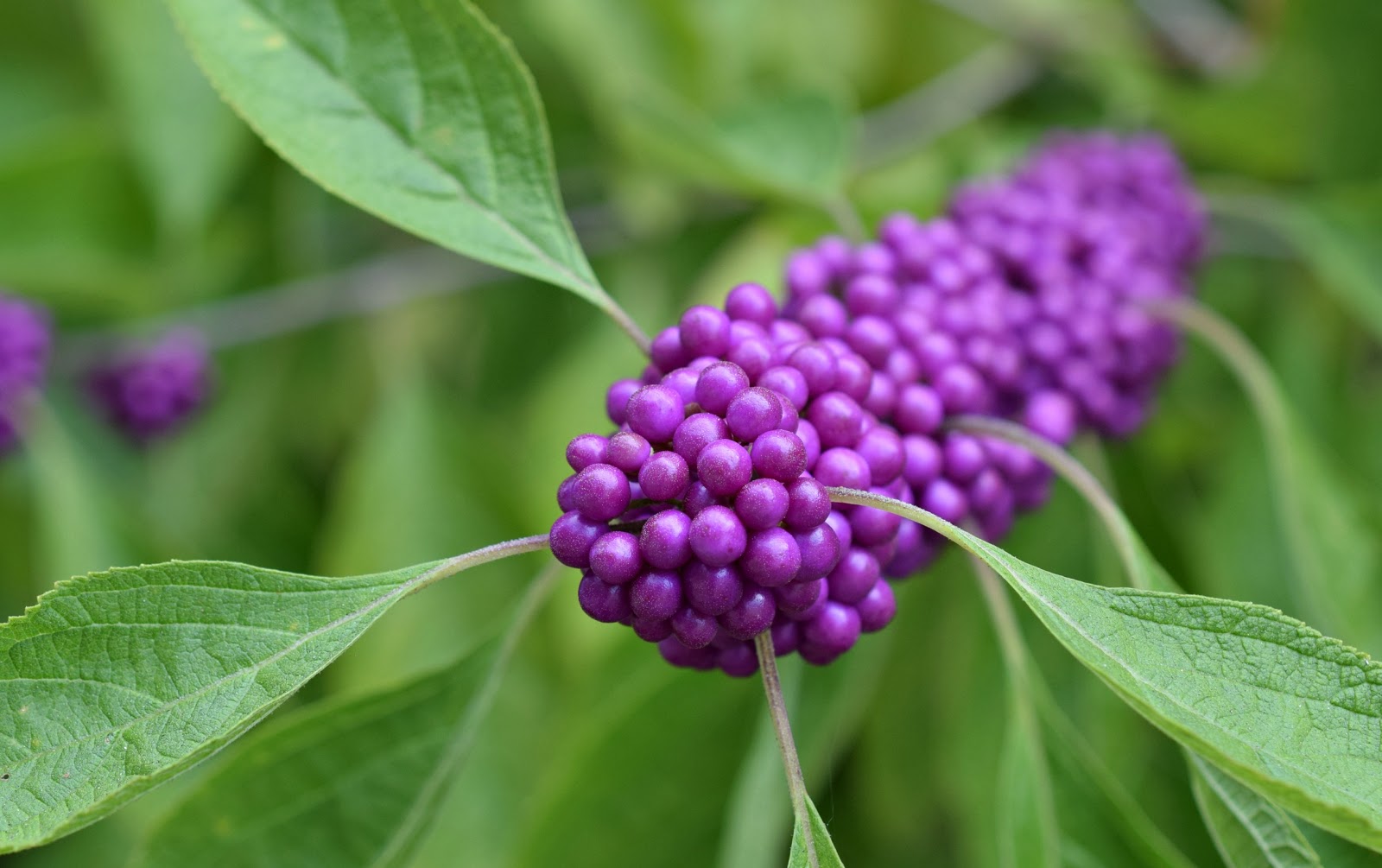
Beautyberry (Callicarpa): The native has the name to match: Callicarpa americana. It also has bigger leaves. Another difference is the position of the flowers and fruit relative to the stem. The native species are closely held to the stem while the Japanese ones have a little bit of length holding them aloft. The difference is noticeable if you see them together so compare some pictures on the internet. Unfortunately, the non-native ones are sold a lot and not always well-labeled.

American beautyberry (Callicarpa americana)

Fringetree (Chionanthus): Look for the one with an American state in the name, Chionanthus virginicus. The non-native one is popping up in nurseries more often as well and is promoted as ‘showier.’ Both have white fringe flowers and the females bear the blue drupes that remind you they are in the olive family.

Redbud (Cercis): Another easy one to choose if you look for the North American name, Cercis canadensis. Although the native species has gained popularity thanks to cultivars (e.g., ‘Forest Pansy’ and ‘Rising Sun’), the Asian ones now have cultivars as well with bigger, more deeply purple flowers and glossy leaves.

Bees love Eastern redbud (Cercis canadensis)

Sweetshrub (Calycanthus): This native shrub (Calycanthus floridus) is wonderful just as it is, but some people decided to hybridize it with Asian relatives. Anything that you find with an ‘x’ in the name means that it has been crossed (for example Calycanthus x ‘Hartlage Wine’). There are native cultivars but they should be labeled with the full name: Calycanthus floridus ’Athens’ or ‘Michael Lindsey.’

Dogwood (Cornus): Flowering dogwood (Cornus florida) has a competitor called kousa dogwood which has similar large, white bracts. It blooms a little later than the native and the fruits are large and not edible by small birds (which is a key feature of the native species).

Flowering dogwood (Cornus florida)

The next time you’re looking for a landscape plant, make sure you know what you’re getting. Some of these have very subtle differences to humans but which are chemically significant to insects. You might find yourself saying “I can’t believe it’s not the native one,” but they’ll know.

Thanks to my very creative husband for the graphic.