Sunday, August 28, 2022

The GGAPC Continues, Year 4


Citizen science projects can really contribute to the data needed and used to understand how a wild organism is faring. There are annual bird counts and butterfly counts nationwide. In Georgia, now wrapping up its fourth year, there is a Pollinator count. This year’s count happened amid a spell of rainy weather but it cleared up enough in my area to count on Saturday.

Despite working with me for the last two years, my grandson was too impatient this year to sit for 15 minutes. He started to count but could not finish and I had to discard his count. I will try with him again next year.  I went on to finish two counts, one on cutleaf coneflower (Rudbeckia laciniata) and another on hollowstem Joe pye weed (Eutrochium fistulosum).  I often use these two plants; they are both usually blooming nicely during the time period of the count (3rd week of August).

Joe pye weed (Eutrochium fistulosum)

The GGAPC website has a summaries of the previous years’ participation, with data on the number of counters, the number of insects counted, and numbers by category:

2019: 4,698 counters tallied over 131,000 insect visits.

2020: 3,746 counters tallied 81,095 insect visits.

2021: 5,941 counters tallied 111,743 insect visits.

Bumble bee on Rudbeckia laciniata

I hope that many researchers are able use the more detailed data (spreadsheets with county and insect details are available) to see how our insect population in Georgia is faring. One goal of the project is to bring more awareness to the general public about the abundance and diversity of pollinators; people are encouraged to prepare by planting more suitable flowers (and native ones, I hope!).

If you’re in Georgia (or South Carolina, it was added as a location this year), I hope you will count with us next year. It only takes 15 minutes and a blooming plant to make it happen. Here are links to my previous blogs on counting efforts in 2019, 2020, and 2021. 

I didn’t have nearly as many butterflies this year (really, I only had one that kept flying from flower to flower), and I was disappointed to not see the elephant mosquito this year (but other people reported it so clearly this is a good time of year to see it).

Carpenter bee on Eutrochium


Sunday, August 21, 2022

August 2022 Moment in Nature

This month’s #amomentinnature was not captured in film and lives only as a beautiful memory. One of my favorite shrubs is my plumleaf native azalea (Rhododendron prunifolium) which blooms in late July and often into August. The shrub sits next to my front porch.

Rhododendron prunifolium

This week, as the last of the azalea’s blooms opened, I passed the window as a hummingbird checked each bright red flower for nectar. It was such a special moment to see her enjoy one of my favorites. I do have a sugar hummingbird feeder but seeing them use the native plants is so rewarding. 

Other plants that I’ve seen them use this year are jewelweed (Impatiens capensis), cardinal flower (Lobelia cardinalis), scarlet sage (Salvia coccinea), scarlet beebalm (Monarda didyma), and my dad’s favorite shrimp plant (a tropical non-native).

Sunday, August 14, 2022

Fall Clematis Lookalikes


I’ve written about native clematis before. For the most part, native clematis look like small bells; a friend used to call them American bells. You can read my earlier post about native clematis here. One clematis, however, is different and its difference leads to confusion with a very similar non-native species; both species are both blooming now.


Clematis virginiana, native
Clematis terniflora, not native


These two clematis species are so similar that I can’t tell them apart by the flower alone. The native species is known as virgin’s bower (Clematis virginiana). The non-native species is known as sweet autumn clematis (Clematis terniflora, also called C. paniculata). Each of them has small, open white flowers with four white petals. Their growth habit is similar and both can be found this time of year flowering profusely on roadsides where they have scrambled above shrubs and perennials to create a snowy, white blanket.


It is the foliage that we must look for when identifying the species of these similar plants. Each species has compound leaves with 3 leaflets (occasionally the non-native may have 5 leaflets and there may be some whitish stripe on the leaflet). The leaflets of the native species have toothed edges (also called dentate) while the leaflets of the non-native species have smooth edges (also called entire).


Clematis virginiana seedheads

Clematis terniflora seedheads


I also find that the seedheads of the native species are much showier, apparently because it has more carpels. See photos above.

You may ask why it matters which one we grow when they look so much alike. I could find no research about which one bugs prefer, either for nectar or for foliage (as a host plant). Given there is still so much insect interaction still unstudied, I prefer to cultivate the native one in the hope that it offers a slight advantage over the species which only recently arrived.


Sunday, August 7, 2022

Meadows Matter


I went up to Big Canoe this week; it is a large, residential community in Pickens County where they have preserved a lot of the natural areas. Along the winding roads, I spied plenty of native ferns, sourwood saplings, and even some dwarf pawpaw shrubs contributing to the cool, leafy-green feeling that is so unlike most residential developments.

I was there to give a talk to the Wildflower Bunch Garden Club about native plants. All the attendees recognized that their community has much natural beauty, thanks in part to the native plants and the natural environment. Someone mentioned a meadow area that had been developed with the help of Audubon and Walter Bland, a longtime GNPS member and owner of Rock Spring Restorations. This area is called McDaniel Meadows. On our way out of Big Canoe, we stopped to visit it and see how it has grown (it was created in 1999).

According to the sign, the meadow area and trail included plants to help create a bird sanctuary as well as be of benefit to pollinators. Berry-producing shrubs included American beautyberry (Callicarpa americana), two species of Viburnum, spicebush (Lindera benzoin), elderberry (Sambucus canadensis), serviceberry (Amelanchier) and even several fruiting paw paws (Asimina triloba). These were on the edges, leaving the meadow relatively open to supporting native perennials and annuals.

A mowed edge for neatness, a bunch of goldenrod; the meadow is much deeper than it appears

I had heard in advance that the meadow wasn’t being managed much so I was curious to see how it was faring. The most noticeable “flaw” was that some of the more aggressive perennials were dominating the space. First and foremost, tall goldenrod (Solidago altissima) was taking up a lot of the space.

Thuggy plants affect plant diversity as they crowd out things that are less capable of holding their ground (for example, they crowd out smaller plants). However, these thuggy plants still contribute: goldenrod hosts more insects (butterflies/moths) than any other perennial. These plants are likely providing significant insect meals for birds that need them (baby birds, warblers, other insectivores).

Lobelia cardinalis
First ironweed bloom


Tall ironweed (Vernonia) was also quite abundant. A cloud of blue blooms in the center turned out to be downy skullcap (Scutellaria incana), while purple passionvine (Passiflora incarnata) twined its way through the plants. A bit of partridge pea (Chamaecrista fasciculata) was evident in the drier areas while cardinal flower (Lobelia cardinalis) thrived in the moist spots. Another area was full of Canada germander (Teucrium canadense), but the flowers were just about spent.

Coreopsis in open areas
Cutleaf coneflower just starting


As we walked the trail, smaller sunny areas were more open and there was mountain mint (Pycnanthemum), Coreopsis, cutleaf coneflower (Rudbeckia laciniata), Joe pye weed (Eutrochium fistulosum), numerous grasses, and the seedheads of spring-blooming false indigo (Baptisia) and Penstemon. Shady areas had bear’s foot (Smallanthus udevalia), Indian plantain (Arnoglossum), elephant’s foot (Elephantopus tomentosus) and natural populations of ferns.

Passionvine and bee
Joe pye and mountain mint


This was an ambitious project, and I think it is largely successful. Bird calls were abundant and I pointed out to my husband how much the birds appreciate these areas where they can feel safe darting in and out of the vegetation. Yet still there are open, sunny areas for birds that need that habitat. That thuggy goldenrod will be a lifesaver when it blooms for late summer butterflies like migrating monarchs (and seed eating birds will feast on the seeds and stem insects all winter). At over 20 years in, there is lots to still admire about this meadow.

Viburnum fruits ready now
Elderberry also ready


Sunday, July 31, 2022

The Floral Backup Plan

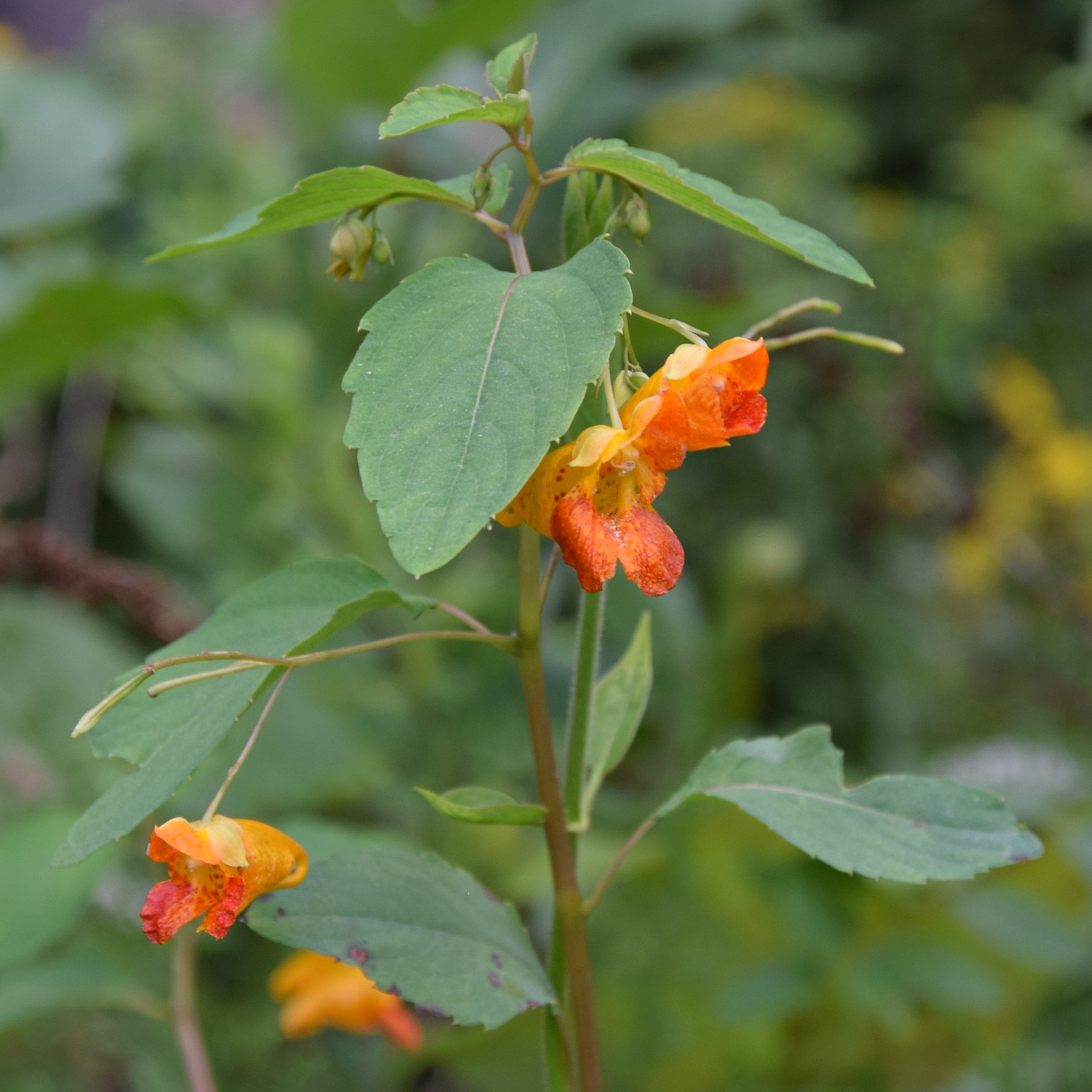
Jewelweed (Impatiens capensis)

Jewelweed (Impatiens capensis) is blooming this week at my house (and has been for a little while). I had one plant last year, an unexpected plant from a stray seed in one of my pots. This year it is in numerous pots as well as growing up in the leaf litter around the pots; annuals apparently don’t always need a lot of root space. One plant is growing in the ground where a seed was transported further away.

This tall, succulent plant is one of our native annual plants; annual plants create a lot of seeds to ensure that the next generation makes it. Since I have more plants this year, I’ve noticed they are susceptible to deer browse. Such browsing would reduce the plant’s chance of reproducing, but this plant has a backup plan.

In addition to the pretty flowers that we see, jewelweed can form some cleistogamous flowers that self-pollinate and create more seed. The showy flowers that we see are chasmogamous flowers. The cleistogamous flowers require less energy from the plant, especially for one that was damaged by grazing. I read an interesting statement from this article: “If the plant is predetermined to develop into both chasmogamous and cleistogamous flowers, we called it dimorphic cleistogamy. Very often, dimorphic cleistogamous flowers occur at different times or in different locations on the plant.” While I already knew that violets can produce cleistogamous flowers at the base of the plant, the article also mentioned that our native American hog-peanut (Amphicarpaea bracteata) does as well (that might explain why I have so much of that too!).


Above, left to right: a seed and the remains of the seed pod; a new seedling; and one of the showy flowers (and it looks like there's an ant inside it).

Many of us know that jewelweed is also called touch-me-not, a reference to the explosive seedpods that open when you touch them. This allows the plant to eject its seeds further away from the original plant. The seeds from the cleistogamous flowers often drop closer to the plant.

Seeds from showy flowers are cross-pollinated by insects and help to create genetically diverse offspring, a benefit to the species in general. Seeds from the cleistogamous flowers are not genetically diverse and are produced as a backup plan to keep the population going until more favorable conditions exist. I know you’re hoping I’ll show you one of those cleistogamous flowers but I haven’t been able to identify one. I found a statement that “Cleistogamous flowers are very small (about 1 mm long) and are borne near the bases of the leaves,” and I found this article with one photo.

Sunday, July 24, 2022

The Ever-changing Roadside

Sabatia angularis

Roadsides can be wonderful places: full of native plants, places of nectar and host plants for butterflies and moths, and sometimes refuges for pockets of diversity. They can also be awful places: tangled in thickets of invasive plant species, ignored areas where seeds land, sprout and thrive.

In my area, I have both kinds of roadsides. During the growing seasons, I try to take time to appreciate the good ones, observing how they are managed and what grows there. This week I noticed bright pink flowers and pulled over to find the annual rose-pink gentian (Sabatia angularis) blooming in an area that was over-mowed last year. This year they are letting it grow, mowing only a six-foot strip next to the road.

Earlier this year, that same strip had lyreleaf sage (Salvia lyrata), Small’s ragwort (Packera anonyma), and daisy fleabane (Erigeron sp. -- all of them important spring-blooming native plants. Currently blooming in addition to the rose-pink gentian is orange milkweed (Asclepias tuberosa), St. John’s wort (Hypericum sp.), and partridge pea (Chamaecrista sp.). In the fall, I can already tell there will be thoroughwort (Eupatorium sp.) and goldenrod (Solidago sp.). Across all the seasons, native grasses fill in the spaces.

Salvia lyrata

Hypericum punctatum


Spring show of Packera anonyma

This place is a natural seasonal progression of pollinator plants, providing both nectar and host plants for a variety of insects. Because of its support for insects, it also provides support for birds that need insects for themselves or their young.

I’ve written about roadsides before; I am very fond of them. If you have the chance to help save one or persuade someone to manage it in a more favorable to insects, please do so. Being able to recognize good plants from bad is the first step to saving the good ones, so plant identification is important.

My previous roadside posts:

Roadsides: Trash or Treasure

Roadside Plants in June

Wild Roadside vs. The Average Garden

Flowers of the Fall Roadside

A roadside combo of Asclepias tuberosa and Passiflora incarnata


Sunday, July 17, 2022

July 2022 Moment in Nature

This #amomentinnature has been a long time coming. I have tried to grow turk's cap lilies (Lilium superbum) for several years. My friend has given me several but I wasn't successful in growing them to flowering size. This year it worked; I had 6 stems mature enough to flower.

Then the moles came through! Four of the six stems were cut off, leaving just two. I dumped sharp gravel into the holes, hoping to save the last two. It worked and both of them bloomed this week.

Lilium superbum


As I admired the blooms one afternoon, a single Eastern Tiger swallowtail butterfly floated into the area. I have seen very few of them this year. So. Very. Few. She came over and sampled the lilies and the nearby Phlox paniculata. 

I took photos as she went from flower to flower. As I looked at the photos later, I realized I had captured a glimpse of her pollination services. 

Her wings collected pollen as she sipped nectar; the pollen was transferred to the next flower as she visited it. What a special moment to witness!


Notice the dark pollen on her wing