Sunday, April 28, 2019

Hemlock Falls Trail


If it’s spring then we must have had another Spring Pilgrimage weekend with the Georgia Botanical Society. This weekend was the Society’s 50th such event, and despite an awful weather forecast, the event went on as planned in the area around Clayton, GA. This blog is about my Friday field trip, one that I actually led yet still enjoyed and saw some great things.

As the leader for this trip, I felt obligated to preview the path ahead of time and I did that in January. I did a blog on that trip because the waterfalls were so amazingly big with the winter rains. Although I knew what the evergreens plants were, all the others were going to be a surprise for me as well as the participants. We found some really cool things (and didn’t get rained on at all!).

Viola rotundifolia

The first 1/3 of the trail is rather plain, with mostly evergreen shrubs and violets. The sweet white violets (Viola blanda) were abundant throughout the trail, their small round leaves and tiny white blooms meeting us at every turn. After a while we saw another round-leaved violet but no blooms on it until much further. With the help of another participant, we figured out it was different than the sweet white and the yellow blooms we finally found confirmed it: Viola rotundifolia. I love how people on BotSoc trips work together to share knowledge.

A very fine Tiarella cordifolia
Xanthorhiza simplicissima


As the path climbed higher, everything was wetter and we began to see some of the spring goodies: foamflower (Tiarella cordifolia), jack-in-the-pulpit (Arisaema triphyllum), and some of the prettiest yellowroot (Xanthorhiza simplicissima) that any of us had seen before. As we continued to make our way towards the falls, crinkleroot, or toothwort, (Cardamine diphylla) and trilliums joined the floral parade.

Erigeron pulchellus - bees love it!
Star chickweed (Stellaria pubera)

We passed through a drier area after a small bridge and found blooming Robin’s plantain (Erigeron pulchellus), star chickweed (Stellaria pubera), and pussytoes (Antennaria sp.). Finally, the path opened up to the falls and a restful area of large rocks for sitting (not that many of us sat, there was too much to see!). We found more crinkleroot, wood anemone (Anemone quinquefolia), and one special plant in abundant bloom: mountain bluets (Houstonia serpyllifolia).

Houstonia serpyllifolia

A wandering stolon on foamflower (Tiarella cordifolia)

Also very interesting in this area was a foamflower (Tiarella cordifolia) with a long stolon that had rooted itself further away. Apparently this is a well-known trait. We saw another instance of this on our Saturday field trip to another location.

Mountain or highland doghobble (Leucothoe fontanesiana)

From there we turned around and made our way back to the parking area. I grabbed a few shots of the blooming mountain doghobble (Leucothoe fontanesiana) along the way, and spotted one broken mountain magnolia (Magnolia fraseri) that was leafing out but not blooming. If it hadn’t been knocked down, I wouldn’t have known it was there.

There are still many blooms to come on that trail as it is loaded with Rhododendron and mountain laurel. It should be a beautiful sight in May.

Sunday, April 21, 2019

Things Change


As plants grow, sometimes I have had to deal with increasing tree canopy creating more shade over time. I have written before about having to trim trees, even remove them, to open the landscape back up for healthy growth on the understory. This month I realized that nature had accomplished that for me when I found a single bloom cluster on an azalea in the woods.

Over the last 3-4 years, a number of trees have naturally fallen during storms in the wooded part of my property. I knew this azalea was there; it is natural to the property and grows along the top of the bank overlooking a small creek. I’ve never seen it bloom even though it is clearly mature enough. It was light that it needed.

My azalea in the woods (Rhododendron canescens)

So while I’m sorry to have lost those trees, the azalea and many other plants will get a chance to grow, bloom, and disperse seeds for a little while until the canopy fills in again. The flowers are open now, revealing that this azalea is a perfectly lovely Piedmont azalea (Rhododendron canescens).

Sunday, April 14, 2019

Eastern Tiger Swallowtail – Georgia State Butterfly


Eastern tiger swallowtail on
crabapple (Malus angustifolia)
The Eastern Tiger Swallowtail butterfly has been on my mind recently. On April 6th, an individual that I’d overwintered finally eclosed (came of its chrysalis) after 7 months! The life cycle of these insects is really amazing. It is certainly fitting that this large butterfly is the state butterfly of Georgia as it is so abundant during the spring and summer.

The 3 color forms – yellow male, yellow female, and dark female – add a bit of interest to its discovery as we try to figure out (in flight!) which one we’re seeing. This blog of mine shows pictures of all 3 forms and talks about comparing to other dark swallowtails.

Two females on Phlox paniculata
Eastern tiger swallowtail on Aesculus parviflora

Recently someone asked on Facebook about what flowers she could plant to support specifically this butterfly in Georgia, so I started thinking about all the native flowers that I’ve seen them on. The following photos were taken from 2014 to this spring. They seem to be a very adaptable adult when it comes to choosing flowers for nectar. In addition to these, I know that they like ironweed (Vernonia sp.), beebalm (Monarda sp.), and coneflower (Echinacea sp.) as well.

On Franklinia alatamaha
On blazingstar (Liatris aspera)


Eastern Tiger Swallowtail on a very ragged
Hibiscus coccineus
On mountain mint
(Pycnanthemum incanum)


On common milkweed (Asclepias syriaca)


Dark female on butterfly weed


This topic would not be complete without mentioning the native host plants that keep this butterfly flying here in Georgia. This butterfly has evolved to use a number of different plants and the females will lay eggs on the leaves of tuliptree (Liriodendron tulipifera), sweetbay magnolia (Magnolia virginiana), ash (Fraxinus sp.), wild cherry (Prunus sp), basswood (Tilia americana), and a few others. I found my caterpillar on green ash (Fraxinus pennsylvanica). If you’d like to support this butterfly, make sure you have at least one of these plants in your landscape.


On Agastache foeniculum
On tall thistle (Cirsium altissimum)


On buttonbush (Cephalanthus occidentalis)
On Rudbeckia laciniata


Female dark/light morph on Eupatorium serotinum

On native azalea (Rhododendron canescens)

On devil's walking stick (Aralia spinosa)

On rosinweed (Silphium sp.)

Sunday, April 7, 2019

I Can't Believe It's Not the Native!


The Southeastern US and several Asian countries (China, Japan, Korea) share a lot of plant relatives and apparently have very similar climate. Many Asian plants do very well here (some of them even do a little too well), and botanists have introduced a lot of them over the years (going way back to the 1700’s).

Some of them have been well-known introductions for many years: Asian azaleas (they are evergreen) and hydrangeas (they have pink and blue blooms) have graced many southern landscapes for years. Some are so intertwined into our natural areas that people don’t even realize they are not native: Japanese honeysuckle (white and yellow flowers) and Chinese/Japanese wisteria (large panicles and fuzzy seed pods) can be found in many ‘wild’ places.


As close as these “cousins” are to our native plants, it’s worth recognizing that they’ve still been separated from ours for long enough that the rest of our local ecosystem doesn’t recognize them well enough. Some estimates put that separation at 135 million years ago! To support the insects and the other critters, it’s still best to choose and use the Georgia natives.

In addition to the azaleas, hydrangeas, honeysuckle, and wisteria are some other plants where non-native cousins have been showing up in the nursery trade. Be careful when you’re shopping so you know what you’re getting, checking not just the common name, but also the genus and species. Use your smartphone to verify on the spot. Recently I saw a plant label for wisteria that had no species name so the buyer would not know what they were getting. Walk away from insufficient information, or let the nursery know that the labeling is inadequate.


Magnolia: Deciduous Asian magnolias have been in nurseries and gardens for years. While there are some deciduous native magnolias, there are no native magnolias with pink flowers. Native deciduous magnolias include M. macrophylla, M. tripetala, M. acuminata, M. pyramidata, and M. fraseri.

Bigleaf magnolia (Magnolia macrophylla)

Viburnum: Non-native viburnums have also been in nurseries and gardens for years.  Some of them, like the snowball viburnum, are quite showy in the spring. Others, like the linden viburnum, have been used to grow berries for birds. Native viburnums include V. dentatum, V. nudum, V. acerifolium, V. opulus  var. americanum (careful, V. opulus is not native, look for the var. americanum), and many others. Read my earlier blog here about viburnums.

Oak (Quercus): Most of the oaks sold in the nursery trade are native with one notable exception – sawtooth oak (Q. acutissima), which is often used in parking lots and other urban settings. This ragged-leaf oak looks similar to chinkapin oak but the fringed acorn caps on sawtooth are distinctive. We have plenty of native oak species to choose from and many of them grow just as quickly or equally well in urban environments.

Euonymus: The non-native burning bush is gaining favor in designed landscapes and is on track to become a real pest in Georgia (the lag time on plant-introduction-to-invasive-plant can be 20-50 years). I see quite a bit of it popping up into natural areas near me. Georgia has two species of native Euonymus but you really don’t find them in nurseries much so anything you find is probably the non-native. In Georgia, Euonymus americanus is the more commonly found of the two.

Hearts a bustin' (Euonymus americanus)

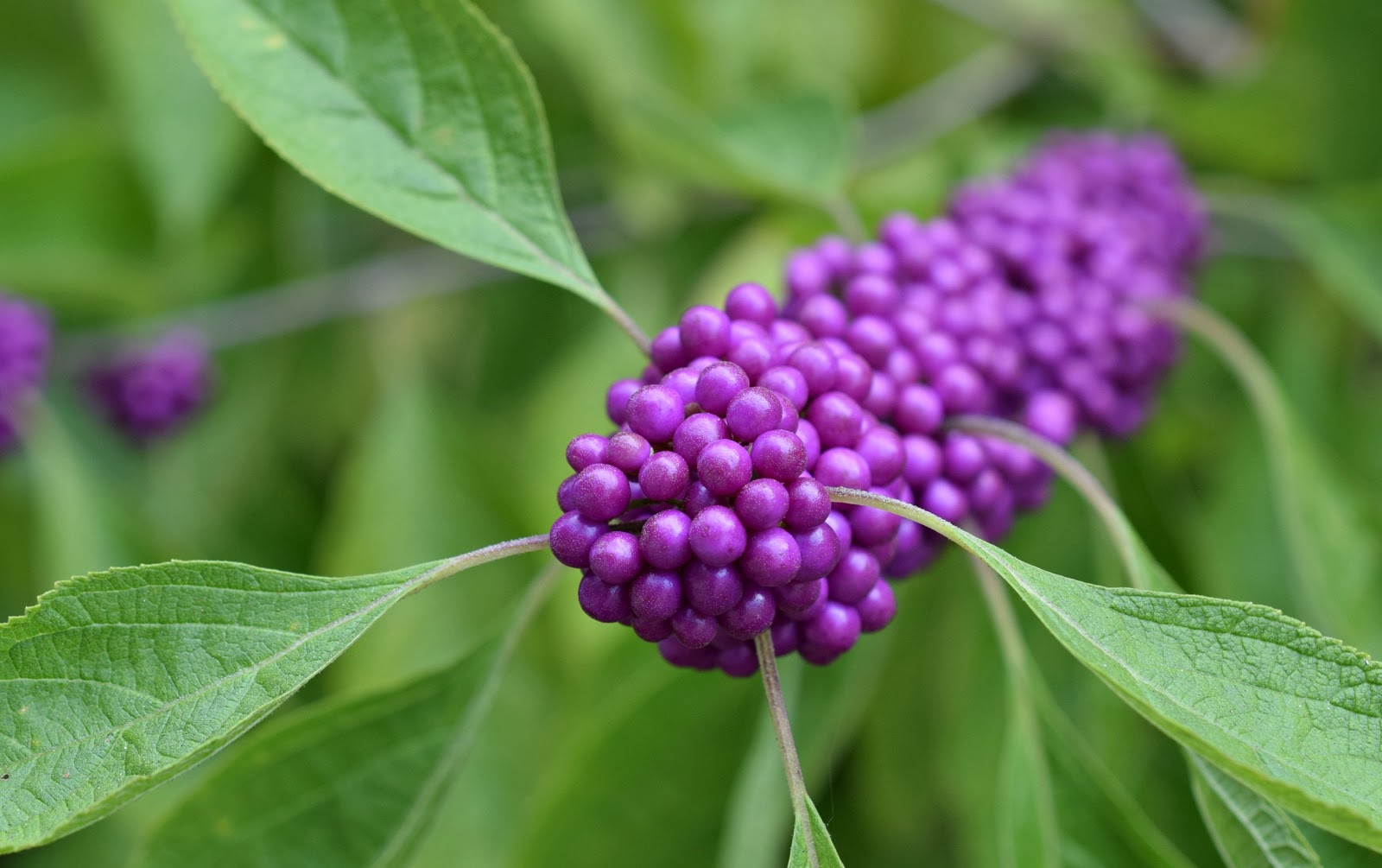
Beautyberry (Callicarpa): The native has the name to match: Callicarpa americana. It also has bigger leaves. Another difference is the position of the flowers and fruit relative to the stem. The native species are closely held to the stem while the Japanese ones have a little bit of length holding them aloft. The difference is noticeable if you see them together so compare some pictures on the internet. Unfortunately, the non-native ones are sold a lot and not always well-labeled.

American beautyberry (Callicarpa americana)

Fringetree (Chionanthus): Look for the one with an American state in the name, Chionanthus virginicus. The non-native one is popping up in nurseries more often as well and is promoted as ‘showier.’ Both have white fringe flowers and the females bear the blue drupes that remind you they are in the olive family.

Redbud (Cercis): Another easy one to choose if you look for the North American name, Cercis canadensis. Although the native species has gained popularity thanks to cultivars (e.g., ‘Forest Pansy’ and ‘Rising Sun’), the Asian ones now have cultivars as well with bigger, more deeply purple flowers and glossy leaves.

Bees love Eastern redbud (Cercis canadensis)

Sweetshrub (Calycanthus): This native shrub (Calycanthus floridus) is wonderful just as it is, but some people decided to hybridize it with Asian relatives. Anything that you find with an ‘x’ in the name means that it has been crossed (for example Calycanthus x ‘Hartlage Wine’). There are native cultivars but they should be labeled with the full name: Calycanthus floridus ’Athens’ or ‘Michael Lindsey.’

Dogwood (Cornus): Flowering dogwood (Cornus florida) has a competitor called kousa dogwood which has similar large, white bracts. It blooms a little later than the native and the fruits are large and not edible by small birds (which is a key feature of the native species).

Flowering dogwood (Cornus florida)

The next time you’re looking for a landscape plant, make sure you know what you’re getting. Some of these have very subtle differences to humans but which are chemically significant to insects. You might find yourself saying “I can’t believe it’s not the native one,” but they’ll know.

Thanks to my very creative husband for the graphic.


Sunday, March 31, 2019

Houstonia, We Have ... Tiny Flowers


Living in the same area for many years means that I see some of the same plants over and over. It’s kind of nice, like seeing old friends. Sometimes, plants that you’ve still seen many times still have the power to impress you more than usual. Bluets (Houstonia spp.) have been that way for me lately.

Of the 8 species of Houstonia found in Georgia, there are spring-blooming ones and summer-blooming ones. Right now, the spring ones are winking up at us from very low on the ground. You probably won’t be surprised to know that these small plants in the madder family (Rubiaceae) have some small native relatives like buttonweed (Diodia), bedstraw (Galium) and partridgeberry (Mitchella). You’d be more surprised to know that buttonbush (Cephalanthus)  and Pinckneya are also in that family!

Houstonia pusilla
Two species of Houstonia are blooming now in my area. The annual tiny bluet is Houstonia pusilla. I can see it in my neighbor’s Bermuda lawn and all along roadsides with closely cropped vegetation, conditions that allow its seeds the bright light and lack of competition that they need to flourish.  It is most often blue but sometimes it is white. The plant blooming now comes from a tiny rosette that formed over the winter. I am still trying to convince it to live in my yard. In the meantime, I admire it from afar. Notice that this species has a reddish-purple center.

The second species is a perennial one: Houstonia caerulea also has a small rosette of tiny leaves. It usually grows a bit taller than the annual species but still not more than 6 inches. Common names include azure bluet and Quaker Ladies. I usually find this one in moist, mossy areas such as a damp ravine. I’m still trying to get this one going in my yard as well. I think it was eaten last year by a more aggressive neighbor. Notice that this species has a yellow center; it shares this characteristic with thymeleaf bluet, Houstonia serpyllifolia, which grows in the mountains, as well as with the Southern annual bluet, Houstonia micrantha.

Houstonia caerulea

A uniquely Coastal Plain species is the round-leaved bluet, Houstonia procumbens. Tiny flowers sprout from creeping foliage in the spring, and the bright whiteness of the flowers evokes another one of its common names: innocence. I saw it on the side of a road in the Okefenokee Swamp during a trip with the Georgia Botanical Society.


Houstonia procumbens

Houstonia longifolia

The remaining 3 species are summer bloomers.  Houstonia canadensis is found in North Georgia and recognized by the presence of basal leaves at flowering time compared to the others in summer. Houstonia longifolia and Houstonia purpurea are similar and more widespread, except for the shape of the leaves. I believe what I found once (and I’m not even sure where) is the long-leaved bluet.

Now that you know these little guys, keep an eye out for them. They are sweet little members of our native plant communities.

Sunday, March 24, 2019

Your Relatives Drive Me Crazy


Cardamine angustata
Slender toothwort (Cardamine angustata, formerly Dentaria heterophylla) is a favorite spring perennial of mine. It first appears in late December when its low foliage braves the winter cold, long before any other ephemeral shows a single sign of life. It won’t bloom until mid-March, after the trout lily (Erythronium umbilicatum) and bloodroot (Sanguinaria canadensis) have won us over with their charms.

Several other species of toothwort have found their way into my garden: cutleaf toothwort (Cardamine concatenata), crinkleroot (Cardamine diphylla), and dissected toothwort (Cardamine dissecta) are all just as lovely, gifts from plant friends over the years. A cousin of theirs, bulbous bittercress (Cardamine bulbosa) came from another friend, transplanted from Greene County, GA.

It is another relative of the toothworts that drives me crazy this time of year: hairy bittercress (Cardamine hirsuta). This cousin - once removed?-  from Europe also pops up in December.  Small rosettes form in slight openings in the lawn, taking advantage of the smallest amount of light. The seeds of this annual were dropped the spring before. I pull every one that I can find, stuffing them into my pockets until I can get inside to trash them. As the weather warms, they pop up faster and faster, seemingly forming slender seedpods – exactly like their other mustard family relatives – almost before I saw their tiny, four-petaled flowers. Argh!

A plateful of hairy bittercress, most of which is going to seed;
if you want to eat it, pick it just before it flowers to get the most foliage.

In the shaded areas of the yard, another favorite is blooming while its cousin also torments me. Starry chickweed (Stellaria pubera) is a lovely native perennial with medium-sized, white flowers in late March and early April.  I love to tell people about this beautiful plant.

Stellaria pubera flower on left; S. media on right
Unfortunately, hearing the name ‘chickweed’ reminds people of its annual cousin, Stellaria media. This pesky weed shows up in the lawn and flower beds. I try to recognize it early and pull it out, but I suspect that I leave a few roots behind to grow again. Argh!

For comparison, I've posed the two flowers side by side; surprise, the native species is much showier!

I suppose I should just give up and make the best of the situation. Both of these weedy relatives are edible. Read more about eating chickweed here and hairy bittercress here (complete with recipes). 

Stellaria media sprawls out from the center

Non-native Cerastium glomeratum

If you’ve heard about the native bittercress (Cardamine pensylvanica), this page has a good description of how it’s different from C. hirsuta.

So hit the road, weedy relatives, and don't let the door hit you on the way out. Be sure to take your even more distant non-native cousin sticky chickweed (Cerastium glomeratum) with you!

Sunday, March 17, 2019

So You Want to Support Pollinators – Part 3


This is the last in a 3-part series on changing at least some of your landscape to support pollinators. The first part (here) was about understanding the benefits of doing so. Last week we covered ‘how to start,’ which included evaluating your space and researching/choosing your plants. As we head into the season of spring native plants sales in Georgia, you’ll want the list of plants you’ve chosen handy. 

You’ve picked your spot and figured out how much sun and moisture it has. You’ve researched your plants and made a list of what you plan to use. Now it’s time to lay out the design. Here are some things to consider:

Grouping plants: Bees, in particular, are better supported by groups of the same plant. Rather than plant one of twenty different things, include 3-5 of each species and plant them in a group so the pollinators can move from flower to flower. Grouping is also more aesthetically pleasing to humans so your design will be attractive to your neighbors as well. Knowing the mature size of the plant will allow you to place them far enough apart to give them room without going further than necessary. For a fuller look, plant closer together but recognize that you might adjust (i.e., move them around) as they reach mature size. Draw out your design on a piece of paper so that you remember what you planned when it comes time to plant.

An example of a design where each number represents a different type of plant

Leave space for ground nesting bees: Leave a few bare areas off to the side so that ground-nesting bees have a safe place to make their nests. These aren’t yellow jackets that I’m talking about, but small, solitary bees that provision for a few eggs and then leave the larvae to grow up on their own. See more information at this link and good pictures at this link.

I noticed this ground-nesting Colletes bee in 2014

Now you can buy your plants! Here are some things to consider:

Source: buy from reputable native plant suppliers, including special spring sales that groups use for fundraising and small, local nurseries who are trying to make a living by growing native plants.

Size: perennials usually come in quart and gallon size; consider the value for what you’re getting, check for bloom buds (know that quarts may not bloom the first year but you might be able to buy more of them) and good root growth. A gallon-sized plant might have just been stepped up from a quart and isn’t any older than the cheaper quart.

Pesticides: ask if the plants were grown with neonicotinoid pesticides; these are harmful to insects and can even have residue present in the nectar and pollen as well as the leaves for the first year. We don’t want to attract pollinators only to harm them.

Prep the ground just before planting by removing any weeds or grasses, amending with compost if you like, and leveling or mounding the ground to fit your design. Install the plants so they are no deeper in the ground than they would have been in the pot (don’t over-dig the depth of your holes or they may sink after being watered). Lightly loosen the roots if they are bound and spread them to the sides to encourage them to explore their new home. Gently press the soil around each plant to reduce air pockets.

I also like to include a few rocks for butterfly basking and for small lizards/salamanders to hide under.  You might even do a puddling station for the butterflies. Adding a tall stick/pole is helpful for dragonflies that might like to visit (and eat a few mosquitoes). Modest amounts of untreated mulch/pinestraw (don’t use the colored mulch, it has chemicals) help retain moisture but leave some un-mulched areas on the edges for ground bees. Water your plants after planting.

Protect your new garden from the harsh realities of nature! Water your plants as needed the first summer and fall if you don’t get sufficient rain. Protect from any deer as needed; I use Liquid Fence but there are other protects and methods to deter them.

The next step is the fun part: Observation! Keep a journal to record what you see, what is doing well, what you wish you had more of, or what did poorly. By sharing your experience with others, you might get more ideas for plants to add in the fall (more native plant sales!).

Left: Southeastern blueberry bee, Center: Tiger swallowtail (dark form); Right: Longhorn beetles 

Here are some specific maintenance tips to consider going forward:

  1. Re-evaluate during the blooming season if your thoughts on light and moisture turned out to be not quite right (too much or too little).
  2. Re-evaluate for quantity and placement of plants (are the big ones crowding out the small ones, do you need more milkweed).
  3. At the end of the season, lightly tidy as needed but leave as many stems, seed heads, and foliage as you can; these harbor small insects for birds to eat during the winter. They may also contain the chrysalides of butterflies.
  4. Come spring, clean up foliage but leave 10-12 inches of stems from the bigger perennials. Stem-nesting bees will use them to harbor the next generation: the year of 2019’s living stems are used in spring of 2020 to make nests and those bees will emerge in spring 2021 (see my previous blog here). I take any foliage that I remove and lightly create a stick pile in a shady area; that way any bugs have a chance to safely emerge.
Have fun, learn from your mistakes, and shout your successes for new people to learn.

Newly planted area in 2014; it is now overtaken by tiny asters and this
Penstemon smallii is nowhere to be found in this bed! Things grow and change.