Sunday, June 27, 2021

Native Plants in our Yards: The Real Thing for Pollinators

I was reading yet another article about insect declines and the impact of their declines on the rest of the ecosystem. Habitat destruction is always a top contributor to the decline. It occurred to me that human residential construction is a type of habitat destruction.  Unlike with a highway or shopping complex, however, WE have an opportunity with our landscapes to bring back some of the life support for insects by focusing on the plants we choose.  In other words, we have the power in our yards to mitigate habitat destruction!


The best approach to repair habitat destruction is to choose to plant native species in your landscape. Native insects evolved with native plants and the vast majority of Lepidoptera (butterflies and moths) depend on native plants to create the next generation (the monarch butterfly, pictured above, is a well-known example of an insect requiring a specific native plant). Using non-native plants is not unlike having plastic plants as far as those insects are concerned – they can’t lay their eggs on them.

Plastic plants or non native plants? Which are host plants?

Remember: we need insects for a healthy bird population (96% of which feed insects to their babies).

Add a serviceberry (Amelanchier) instead of crape myrtle in your landscape. Use native upright grasses instead of non-native miscanthus grass. Minimize your lawn - add more productive native plants to that sunny space instead. Use flowering native perennial groupings that include plants for spring, summer, and fall for blooms across all seasons. 

Do you need to have all native plants? I like to suggest something akin to the food pyramid: mostly native with a sprinkling of non-native plants (particularly annuals for extra blooms).


Another important consideration is to pick regionally appropriate plants. Georgia is a very big state and what is native to north Georgia is not always native to south Georgia (and vice versa). Certainly we have oaks and goldenrods (two of my favorites) throughout the state but the specific species may vary; choose the species that will do best in your area. Some plants like the Florida anise shrub (Illicium floridanum) are native to south Georgia (one county) but are planted well up into metro Atlanta. Do the insects that use it fly that far north? Use it sparingly and focus on more local shrubs.

If we're gardening for pollinators and wildlife, our best option is to use the real thing. The plants that co-evolved with our native insects. Anything else is just for looks. 

Sunday, June 20, 2021

A Moment in Nature for June

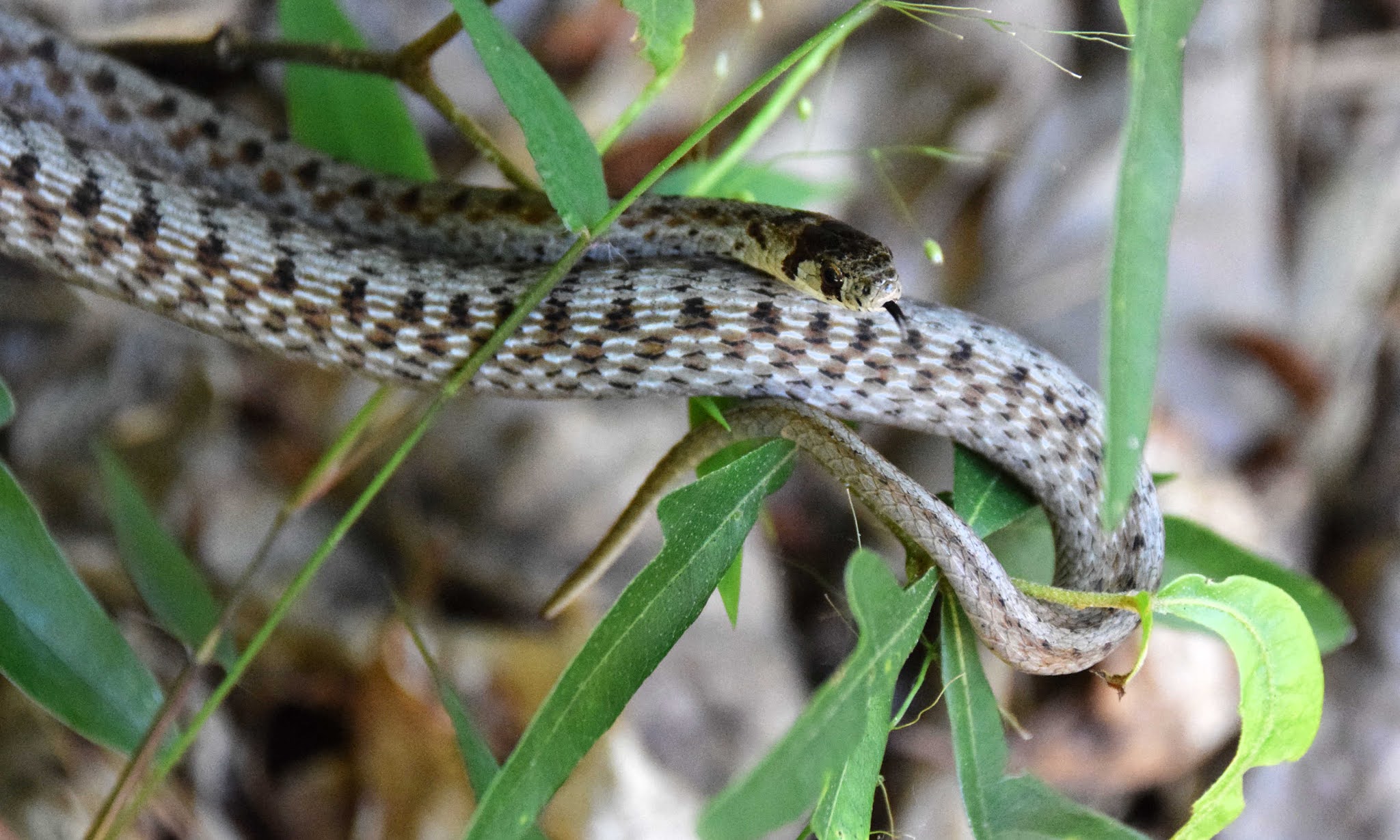
Following on the post I shared for May, #amomentinnature for June is a small Dekay's brown snake that I uncovered in the mulch pile. I have had a pile of tree trimmings on the hot driveway for over a year and this week I decided to finish distributing it in advance of getting a new load. Small reptiles have enjoyed the pile, using the heat of it to warm up. Earlier I found what appear to be snake eggs in it.

Dekay's brown snake on oak sapling with grass

This small and relatively common snake was just under the top layer and she appeared to be pregnant. I used a stick to relocate her to the side of the driveway where she rested for a while in a small oak sapling.  I took some of the pile and created a small mound near her. Later I saw her moving through the upper layers and she looked thinner. 

Harmless Dekay's brown snake in mulch

I enjoy finding wildlife in my yard. We also found the first box turtles of the year this week. They were busy making more box turtles!


Sunday, June 13, 2021

Another Snake Plant

Why do so many plants have ‘snake’ in the common name? When I recently discovered a new to me plant with snake in the name, I decided to see how many others I already have. [Of course this is a partial list of the many plants with snake as part of the common name.] Apparently some plants got the name because the plant was thought to have curative properties for snake bites. Unfortunately, that may not be true (but if it is, I am well stocked!).

Ageratina altissima, white snakeroot
Aristolochia serpentaria, Virginia snakeroot (now Endodeca serpentaria)
Botrychium virginianum, rattlesnake fern (now Botrypus virginianus)
Eryngium yuccifolium, rattlesnake master
Goodyera pubescens, rattlesnake plantain
Hieracium venosum, rattlesnake weed
Orbexilum pedunculatum, Sampson’s snakeroot
Prenanthes altissima, tall rattlesnakeroot (now Nabalus altissimus)
Sanicula canadensis, black snakeroot

Orbexilum pedunculatum

So, what was the new plant? It is Sampson’s snakeroot (Orbexilum pedunculatum). It is a member of the bean family, Fabaceae. We found it on a rescue site that we’ve had for a long time. I actually thought it was a type of milkwort (Polygala) which is not in the same family at all but the tiny flowers seemed similar (especially if you’re not wearing your glasses, which is true for me in the field!).

As this new plant started to bloom this spring, similar looking plants started appearing in plant identification groups on Facebook.  After it was suggested that they were Orbexilum pedunculatum, I examined mine again. Bingo! 


From the trifoliate leaves to the shaded hues on the inflorescence, it was a perfect match. I love learning about new plants even if they are snake plants!

Orbexilum pedunculatum


Sunday, June 6, 2021

Zizia and Thaspium

I have been on field trips with the Georgia Botanical Society where we encountered a yellow-flowering member of the Apiaceae family. My first thought at the time was Zizia (known as golden Alexander) but the more knowledgeable folks started a discussion about how it could be Thaspium (known as woodland meadow parsnip). I was new at the time and didn’t catch the finer points of the discussion but it was enough to stick in my mind that these could be confused.

Rescued plant

Last year I rescued a plant in the winter that looked like something in the Apiaceae family. I love getting new native host plants (Apiaceae family plants are hosts for the Eastern Black swallowtail butterfly), so I rescued it. Like my Zizia, it kept some foliage all winter. Picture at left blooming in 2021.

I planted it in a sunny moist area (I found it in a moist area) and this year the flowers were spectacular. My already established Zizia aurea was a bit later to flower, but when it did, I now had some comparisons to make and off I went to find the identification points to help me. The leaves were past the basal growth phase but I found some points about the flowers and the seeds.


An umbellet (Zizia)
I like to use Weakley’s Flora of the Southeastern US (yes it is big but the “find” function – CTRL F on a PC – works quite well) and was very surprised to find these plants in multiple Apiaceae keys with clues for using flowers as well as fruit (and the key acknowledges it is hard to separate these without having the fruit). An important point here is whether the central flower (or fruit) of each umbellet (see photo) has a pedicel (a stalk).


According to the keys, the central flower on Zizia does not have a pedicel while on Thaspium, the central flower does have one. Here are photos from my plants. I had to cut away some of the flowers to show the center more clearly. The rescued plant has all flowers on pedicels while the known Zizia shows a short flower at center.

Mystery showing central flower
Zizia showing central flower


In addition to having the two yellow blooming plants, I also have a purple-flowering plant that is definitely Thaspium trifoliatum var. trifoliatum so that has been helpful to use as well in evaluating presence of a stalk on the central flower. Here are pictures of the plants in my yard now gone to seed. The mystery and the purple Thaspium are showing seeds on elongated stalks (pedicel) while the Zizia has that noticeably short one in the center.

Yellow mystery
Zizia
Purple Thaspium

Note that the seeds of the mystery flower are ribbed which is one of the points mentioned in the key for Zizia (see below) so that compounds the mystery a bit. [Although my Zizia's seeds aren't as ribbed.] Apparently I should have looked more closely at the mystery flower to see if the central flower was staminate as it is valid for Zizia to have a pedicel on the central flower when it is also staminate (having stamens).

So I guess the mystery may last another year until it blooms again and I can check that central flower more closely. None of my pictures from this year is clear enough to tell now. I do hope my exercise here will help some other folks regarding these two plants.

Note for those curious about the name golden Alexander: Zizia aurea was first classified as Smyrnium aureum but was changed in 1825. The common name is believed to refer to an old herb from Roman times called Alexanders (Smyrnium olusatrum) and named for the city of Alexandria.

Here are snippets of two of the keys from Weakley’s Flora of the Southeastern US:


Sunday, May 30, 2021

Rhododendron minus is a Big Plus to Me


The genus Rhododendron consists of native azaleas (which are deciduous) and native evergreen plants commonly referred to as rhododendrons. The smallest of the evergreen rhododendrons is one called Rhododendron minus. It looks a bit like a native azalea but it has leaves that stay on the plant all winter, with fresh ones emerging in the spring.

I enjoy finding it in natural areas in May and June and have been delighted recently to find it in the metro Atlanta area in several locations: Blue Heron Nature Preserve and the Vickery Creek Trail at Roswell Mill. I’ve also seen it at Providence Canyon State Park in southwest Georgia and at FDR State Park in middle Georgia.

Last week I went to Vickery Creek to see the blooms and my timing was perfect. The range in bloom color is pale pink, almost white, to deep pink. Some of the blooms are arranged in perfect spheres while others are more loosely held.

Vickery Creek
Vickery Creek


FDR State Park

At Vickery Creek it was high on the slopes above the creek, mixed with still-blooming mountain laurel(Kalmia latifolia), bigleaf magnolia (Magnolia macrophylla), sweetshrub (Calycanthus floridus), and smooth hydrangea (Hydrangea arborescens).

Rhododendron minus

You might find my blog about Rhododendron maximum interesting too. Known as the great laurel, it usually blooms about a month later.


Sunday, May 23, 2021

Is Your Yard NIIT?

It would be an understatement to say that plants occupy a significant part of my every day thinking. However, I recognize that is not true for most people. Plants are often simply the outside decoration of one’s property (the house being the inside). For most people, plants are something to have and to control (“I have to mow the lawn.”). It often doesn’t even matter what the plants are.  As result, plants that were not even planted by the owner come into the landscape and benefit from one or more of the components of NIIT: neglect, indifference, ignorance, and tolerance.

Plants will pop up anywhere they can ...

Neglect: as in not maintaining the property; it is often associated with properties where the owner does not reside but it can also be the property of someone not physically able to address it.

Indifference: as in not caring about what is there perhaps due to lack of interest (“just need to have some bushes and grass”).

Ignorance: as in not being knowledgeable about the different plants (“A tree is a tree is a tree, right?”). Or "If it came in by itself then it must be native." Or "It was already here when I got here so it must be native." No, no, and no.

Tolerance: as in knowing what you have, notably something invasive, and being ok with it (“that English ivy growing up the trees is fine”).

Tolerance

While neglect is not something we can always improve, except perhaps by volunteering to help the owner (especially an elderly or disabled owner), the other 3 components are something we can overcome. The key is learning why it matters to care, to learn, and to act.

Why care:

Our yards are home to thousands of native bugs, birds, and critters. In heavily developed areas, our yard (and those of our neighbors) can provide small pockets of refuge for creatures that depend on native plants because of their specialized diet. Think of the monarch butterfly and her need to lay eggs only on milkweed. There are many other insects like that. Or think of the baby birds who need insects to grow; a robust insect (and bird) population depends on native plants. Some of my earlier blogs include:

If Not You then Who?

Why Native Plants Help Birds Better

Why Native Plants Are Better for Bees and Pollinators

How to learn what you have:

It has never been easier to identify plants in your yard thanks to smartphones and tablets (e.g., iPads) and the internet. Plant identification groups on Facebook are numerous; I participate in one called Georgia Native Wildflowers and Plants. Here is an earlier blog about using apps and the internet to figure out what you have. Parks and public green spaces can be just as guilty about the ignorance aspect. If you notice invasive plants there, contact the park and let them know (and volunteer to help remove); plants can spread further from public spaces when left to grow.

Ignorance (this is Tree of Heaven)

How to act on what you have:

Remove invasive plants from your yard to make a place for the native ones. Often the native plants are there, waiting to recover once the invasive plants are removed. If not, we now have more native plant nurseries than ever; find one and add some life to your yard. Here are some of my earlier blogs on removing invasive plants. It is easier to remove when the plant has first arrived than after it has spread a lot.

Declare Independence from English Ivy

Remove Invasive Plants Early for Best Results

I hope you will take charge of knowing what is in your yard and root out unwanted invaders. Don't be the NIIT one!

Sunday, May 16, 2021

A Moment in Nature for May

Following on the post I shared for April, #amomentinnature for May is a baby chickadee that got briefly stuck in our garage. I didn't realize that these babies don't fly yet. It was calling and calling for its parents. I was able to pick it up and carry it over to a small tree. Shortly thereafter, I was able to see its parents bringing food to it.

It likely was a baby from a nest in one of our boxes. I had seen the chickadees coming and going to the box. The garage is not too far from that box and I had left the door open after we got home from an errand. It must have fledged and hopped over that way.


These small interactions with nature help to remind me that my yard is meant to be a haven for wildlife. The insects that adult birds need to raise chicks is an important part of why I garden with native plants.

Here are some of my earlier posts on gardening for birds: