Sunday, May 18, 2014

The Flower You Didn’t See


Most flowers are showy and they capture our attention during their designated bloom time. Their flowers turn to fruit of some kind (even if they are dry seeds like the big sunflower) and we make the connection that flowers make fruit. Sometimes the fruit is so subtle that we don’t even realize the plant made fruit. Other times the flower doesn’t get pollinated and fruit does not form.

Tiny flowers on black gum (Nyssa sylvatica)

In some plants it is the flower that is so subtle that when fruit does form, we are mystified. I have heard this statement on identification forums many times: “This plant doesn’t flower but it has this fruit.” Well, unless the plant is a fern, it has a flower even if you didn’t see it.


Flowers on sedge

Grasses, sedges and rushes (which one might think are all “grasses”) are a significant group of plants that some people consider to be non–flowering plants. Rather than having showy flowers to attract insects, grasses have flowers without petals. This lack of petals facilitates the transfer of pollen through wind-pollination. Pollen is more easily discharged and received from flower to flower when petals are absent.

There is also a group of woody plants that are wind-pollinated. Like the grasses, they have flowers without petals. And like the grasses, these are usually the plants that cause allergies because their pollen is windborne: oaks, pines, mulberries, elms, hickories (including pecan) and sweetgums are the major contributors.  They produce a lot of pollen to ensure that some gets to where it needs to be.

Hickory (Carya spp.) flowers


Sometimes you only see the flowers of these trees when they fall to the ground (although some people still don’t realize what they are seeing).

Sweetgum (Liquidambar) flowers surrounded by male pine (Pinus) flowers


There are also some non-woody, non-grass-like plants that have flowers without petals. Ragweed is probably the most familiar one. It is also wind-pollinated.


Nyssa sylvatica fruit comes from tiny flowers (see 1st picture)
Most plants have insect-pollinated flowers, usually flowers with petals which are meant to attract insects. 

However, the flowers or petals are so tiny that humans overlook them. Rest assured though, if you see fruit then you know that the flower was able to catch the attention of an insect, even if it was a tiny one.

Black gum (Nyssa) is one such plant with tiny flowers. Another is poison ivy (Toxicodendron radicans). Black willow (Salix nigra) doesn't have petals but it has nectar and that attracts insects like bees.

Female Salix nigra flowers in fruiting stage
Callicarpa americana flowers in July

The flowers of beautyberry (Callicarpa americana) and winterberry (Ilex verticillata) are rather small as well but are probably showy enough that people notice them.


So next time you think to say that a certain plant doesn't have flowers ... think again.

Bees love Ilex verticillata flowers


Sunday, May 11, 2014

Awesome, Easy, Native Perennials for Georgia Gardens


This week is an outstanding week for blooming spring perennials. I was standing there admiring the cheerful collection of blooms on my mouse-eared coreopsis (Coreopsis auriculata) and I thought “Wow, more people should have this plant!” Then I took two steps and noticed the clouds of purple blooms on the beardtongue (Penstemon smallii) and thought the same thing.

Mouse-eared coreopsis (Coreopsis auriculata)

Come to think of it, there are a lot of very dependable native perennials that you might consider using. As always, take these as suggestions and do your own research as to availability, site suitability and native range for your area.  These are plants that I personally have found to be tolerant of a variety of conditions, forgiving in times of forgetfulness, and able to rebound after problems (like deer munching).

Penstemon smallii


So here are a few of my favorite ones that are particularly awesome and easy. It’s a surprisingly big list when you consider all the seasons.


Spring: foamflower (Tiarella cordifolia), Solomon’s plume (Maianthemum racemosum) and our evergreen gingers (Hexastylis) are real standouts in part shade. Showier spring flowers include red columbine (Aquilegia canadensis), beardtongue (Penstemon) and tickseed (Coreopsis). Most people have great success with blooming groundcovers like the native creeping phlox (Phlox subulata) and green ‘n’ gold (Chrysogonum virginianum).

Aquilegia canadensis

Rudbeckia hirta with spider and bee


Summer: Black-eyed Susan (Rudbeckia hirta) and its orange coneflower relatives (R. fulgida), annual red salvia (Salvia coccinea), butterfly milkweed (Asclepias tuberosa), pale bergamot (Monarda fistulosa), mountain mints (Pycnanthemum), wild quinine (Parthenium integrifolium) and spiderwort (Tradescantia). Shade tolerant superstars are black cohosh (Actaea racemosa) and fly poison (Amianthium muscitoxicum).

Mountain mints (Pycnanthemum) are pollinator magnets!


Georgia aster (Symphyotrichum georgianum)

Fall: sunflowers (Helianthus), clump-forming goldenrods (Solidago), blazing stars (Liatris), thoroughworts (Eupatorium), and asters (Symphyotrichum). The blues, whites and yellows of fall flowers make for amazing combinations.

The late fall flowers of Helianthus angustifolius

Need more suggestions? Check out my other posts about spring and summer perennials (where for some reason I put beardtongue in the summer category). Hmm, I didn’t make a fall one? I need to add that to my list of things to do. I do have some posts on specific fall perennials like Helianthus, goldenrod (Solidago), and asters (Symphyotrichum).

Note: my perspective is from the Piedmont area of Georgia (Atlanta area). You can find some information about Coastal Plain plants on the publications area of the website for the Georgia Native Plant Society. Or search this website using the term Coastal Plain.

Sunday, May 4, 2014

Black Cherry Butterflies


Butterfly gardening is a popular topic. Private and public gardens love to create butterfly gardens, artfully arranging combinations of parsley, fennel, milkweed and flowering nectar plants. Parsley and fennel are two well-known garden host plants for butterflies and of course milkweed for monarch butterflies is a hot topic these days.

A newly emerged red-spotted purple (Limenitis arthemis)

Yet not far from these butterfly gardens is a plant that supports far more butterflies and moths than those 3 plants combined. It is a plant that is overlooked, under appreciated and downright disparaged at times. Meet black cherry, Prunus serotina.

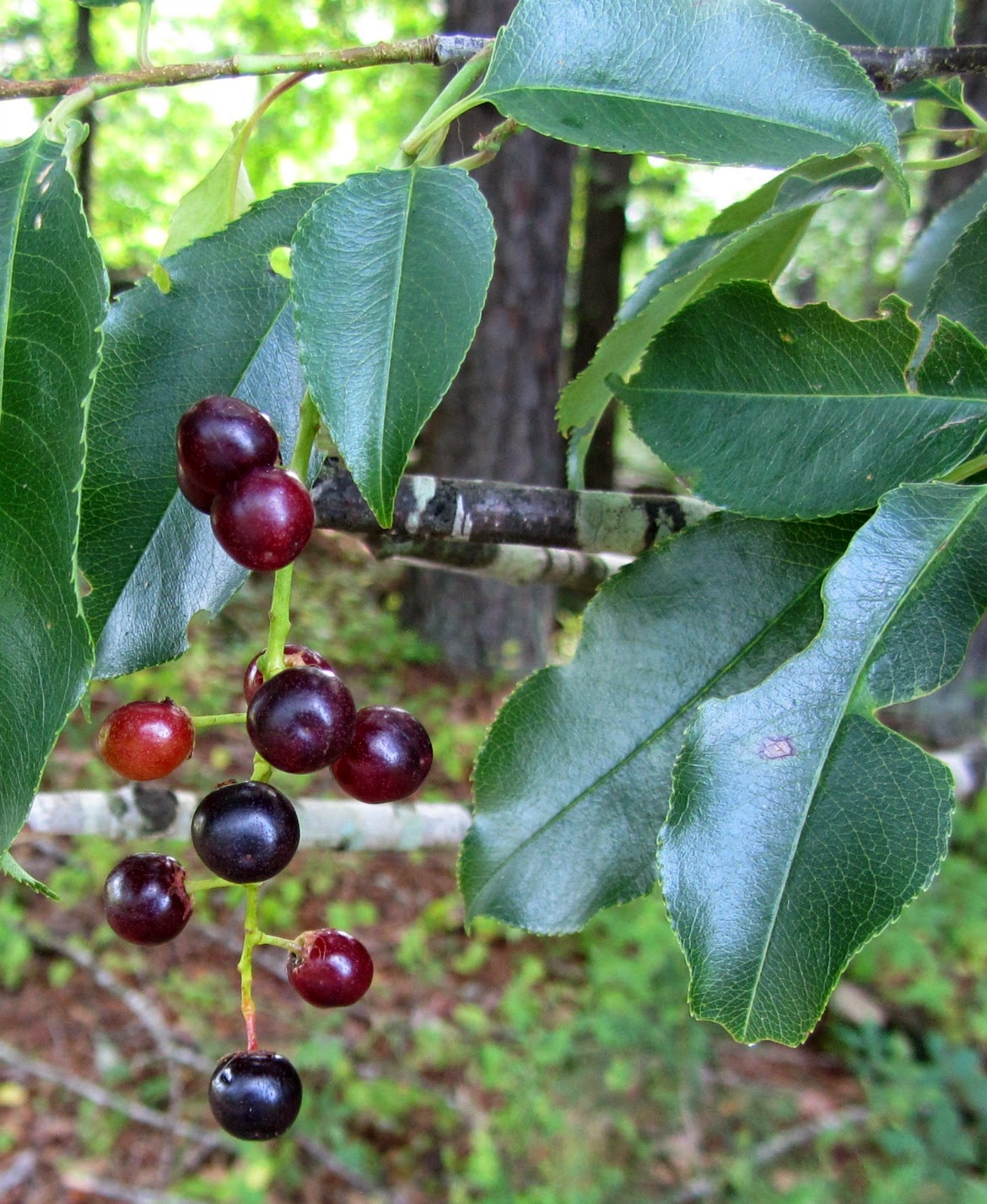
Black cherry is native throughout Georgia, from the mountains to the coastal plain. It is considered a medium sized tree although it can reach a height of almost 100 feet in ideal conditions. It blooms in April - long drooping racemes of creamy white flowers that are popular with native bees and other early pollinators. Pollinated flowers become clusters of red-black fruit that are eaten by birds (and even humans).

April flowers of Prunus serotina

Ripening fruit and caterpillar-chewed leaves

According to research by Doug Tallamy and his team, the Prunus genus supports at least 456 different species of Lepidoptera (butterflies and moths). Native cherry trees like the black cherry are host plants for Eastern Tiger Swallowtails, Red-spotted purples, Cecropia moths, Coral and Striped Hairstreaks, White Admirals and many others.

You might already have it in your yard. Look around for it.

Furcula caterpillar (with fungus) on Prunus serotina


How do parsley, fennel and milkweed stack up against black cherry? Both parsley and fennel are in the Apiaceae family which supports less than 50 native Lepidoptera species in the whole family (across all genera in that family).  Milkweed (Asclepias) supports about 12.


So there you have it, 456 species for Prunus compared to 50 for parsley/fennel and 12 for milkweed. No disrespect to the monarch and other butterflies, but how many butterflies do you want to support?  Make sure that a black cherry is not far from your butterfly garden and your impact will be exponentially better than without it.