Showing posts sorted by relevance for query coastal plain. Sort by date Show all posts

Sunday, May 14, 2017

Coreopsis in the Garden

I often describe purple coneflower as the native plant perennial poster child because it is well-liked and fairly available. When talking to people about native perennials that they might use in their garden, you can mention purple coneflower (Echinacea spp.) and heads start nodding. After purple coneflower, a close second is black-eyed Susan (Rudbeckia spp.); people are usually familiar with that dependable garden staple. I think that Coreopsis should be the next big garden thing.

Coreopsis gladiata on a south Georgia field trip
This genus of flowering plants has both annual and perennial members, 18 of which are found in Georgia. They range in habitat from sunny and dry to sunny and swampy, and can be found throughout Georgia.

One species is considered more shade tolerant (Coreopsis latifolia) but they really like sun. Most of them are yellow, but several species have pink flowers. Several are noted as host plants for the moths Tornos scolopacinarius (Dimorphic Gray) and Enychlora acida (Wavy-Lined Emerald).

I have had experience with a few of them in my garden. I couldn’t live without the dependable blooms of mouse-eared coreopsis (C. auriculata) in the spring. Its spreading ways ensure that it winds its way through the garden, pairing with all sorts of spring perennials. It and lanceleaf coreopsis (C. lanceolata), which I’m also growing, are usually available at most spring sales. Whorled coreopsis (C. major) is a long-blooming summer standout for the dry area of the garden. Like others, it is usually covered in small bees.

Coreopsis auriculata can make a nice groundcover
More and more I appreciate some of our native annuals, and I am thrilled that Chattahoochee Nature Center continues to grow the Plains coreopsis (C. tinctoria) for their spring sales. I first fell in love with this yellow and red flower at a workday on a TNC property in Floyd County. I’ve also seen it growing on the side of the road a couple miles from my house. It’s sometimes included in wildflower seed packets.

Coreopsis tinctoria, an annual
Coreopsis tinctoria


And I recently got some of the thread-leaf coreopsis (C. verticillata) from a friend. It’s a nice texture to add to the garden and I hope it does well here; so far all I know is that it survived the winter.

This species, as well as several others, have cultivars developed by the nursery industry. While there is some concern over using only cultivars (it reduces genetic diversity to only use one), it generally means that you have a better chance of finding it for sale when showier forms are being propagated.

Whorled coreopsis (C. major) with pollinator
Coreopsis rosea


As always, do your own research and weigh the pros and cons. Here’s a list of the 18 species in Georgia:

Coreopsis auriculata – Piedmont/upper Coastal Plain, perennial, yellow, spreading, spring bloomer

Coreopsis basalis – Coastal Plain, annual, yellow with dark center, summer bloomer

Coreopsis delphiniifolia – throughout Georgia, perennial, yellow, summer bloomer

Coreopsis falcata  - Coastal Plain, perennial, yellow with dark center, summer bloomer

Coreopsis gladiata - Coastal Plain, perennial, yellow with dark center, fall bloomer

Coreopsis grandiflora – middle Georgia, perennial, yellow, summer bloomer

Coreopsis integrifolia - Coastal Plain, perennial, yellow with dark center, late summer bloomer

Coreopsis lanceolata – throughout Georgia, perennial, yellow, spring bloomer

Coreopsis latifolia – one northern county, perennial, yellow, shade tolerant, summer bloomer

Coreopsis linifolia – Coastal Plain, perennial, yellow with dark center, late summer bloomer

Coreopsis major – throughout Georgia, perennial, yellow, summer bloomer

Coreopsis nudata – Coastal Plain, perennial, pink, spring bloomer

Coreopsis palustris – one southern county, perennial, yellow with dark center, fall bloomer

Coreopsis pubescens – throughout Georgia, perennial, yellow, summer bloomer

Coreopsis rosea – northern Georgia, perennial, pink, summer bloomer

Coreopsis tinctoria – scattered distribution in Georgia, annual, yellow with red, summer bloomer

Coreopsis tripteris – scattered distribution in Georgia, perennial, yellow with dark center, summer bloomer

Coreopsis verticillata – no specific county records but likely, perennial , yellow, summer bloomer

Coreopsis grandiflora
I like to check out small nurseries from time to time and about a month ago I picked up some 1 gallon-sized Coreopsis lanceolata at Plant Life Nursery in Rome.

The plants were healthy and large; I think they were 3 for $11. Visit that nursery for natives if you’re in the area; it’s a nice, local business.

Sunday, December 15, 2013

Georgia's Coastal Plain Ecoregion


In the concept of plant communities, Georgia is divided in 5 ecoregions. In an earlier post this year I wrote about a new book that came out in 2013 which covers these ecoregions in great (and wonderful) detail. In that post I outlined a little about my own ecoregion, the Piedmont. This week I finally got a chance to read the section on the Coastal Plain ecoregion.

Longleaf pine, Pinus palustris, an important part of the Coastal Plain ecoregion

The Coastal Plain area of Georgia encompasses more acreage than any other ecoregion, approximately 22,045,897 acres or 35,650 square miles. When I first heard the term “Coastal Plain,” the word “coastal” confused me. The area encompasses the state south of the Fall Line and includes a vast area that stretches from Alabama to the coast, and equals more than half the state. How, I wondered, could the area so far away from the coast be called “coastal”?

Well, I think the answer lies in not what it is now, but what it used to be. Since the Cretaceous period, the waters of the surrounding oceans (what is now the Atlantic Ocean and the Gulf of Mexico) have advanced and retreated over this region. As a result, the area is defined by flat broad plains with mixed layers of sands and clays. Areas with more sand tend to be dry while areas with clay layers near the surface tend to hold water longer.

Butterfly pea, Clitoria mariana, a native legume found in dry upland longleaf pine woodlands
As I mentioned in my other post on this book: the ecoregion itself is broadly defined while the details are found in the more specific natural communities within it. For the Coastal Plain ecoregion, 3 groupings are defined; those groups and the natural communities within them are:

Upland Forests

  • Sandhills and River Dunes
  • Dry Upland Longlef Pine Woodlands
  • Mesic Upland Longleaf Pine Woodlands
  • Dry Evergreen Oak Woodlands
  • Dry Deciduous Hardwood Forests
  • Mesic Slope Forests

Rock Outcrops, Prairies, and Barrens

  • Acidic Glades, Barrens and Rocky Woodlands
  • Blackland Prairies and Woodlands

Wetlands and Lowlands

  • Pine Flatwoods
  • Seepage Slope Herb Bogs
  • Seepage Slope Swamps and Shrub Bogs
  • Depression Marshes and Cypress Savannas
  • Cypress-Gum Ponds
  • Depression Oak Forests
  • Cypress-Tupelo River Swamps
  • Bottomland Hardwoods
  • Riverbanks and Levees
  • Small Stream Floodplain Forests
  • Okefenokee Swamp

Devilwood, Osmanthus americanus, mesic slope forests
Each community is covered in detail: an introduction that summarizes the key traits of the community; physical setting and ecology; vegetation; animals; a featured animal and a featured place. The featured place description is a real treat: it describes a site where an example of that community can be viewed by the public and includes directions to it. Each community also has a section of characteristic plants.

These all look like fabulous places to visit. The Georgia Botanical Society has field trips throughout the state over the course of their 12 month schedule. I recognized several places as being on the 2014 field trip list: Big Hammock Natural Area (page 399) is scheduled for a field trip on June 21. Montezuma Bluffs (page 411) is scheduled for March 16th. Townsend WMA/Altamaha River (page 445) is May 17th. Their annual 3-day pilgrimage will be in the Okefenokee Swamp area (page 494). You can visit the Fall Line Sandhills WMA (page 373) on Sept 13 or see an example of Blackland Prairies at the Oaky Woods (page 423) weekend trip on Oct 11-12. There are probably more in the schedule (which should be published soon).

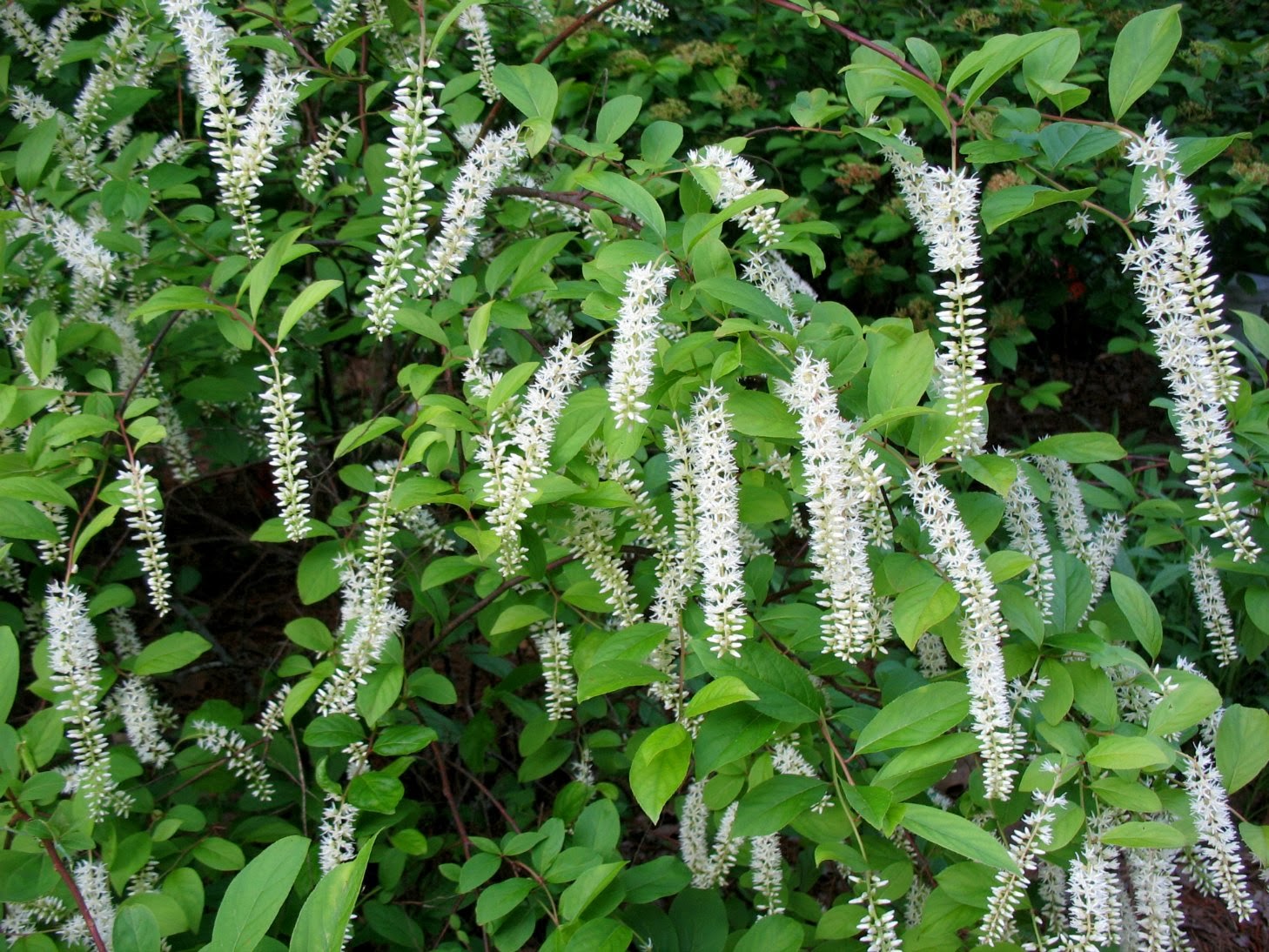
Virginia-willow (Itea virginica), cypress-gum ponds and riverbanks
I'd like to point out is that in reading about these unique places, it is clear that the Georgia Department of Natural Resources (GA DNR) Nongame Conservation Section is an important factor in conserving some very special habitats. So many of the "featured places" in the book mention their management or their involvement. They deserve our support, especially since they are often the target of budget cutbacks.


It is clear in reading about this ecoregion that it has an amazing range of habitats. While they are all based in their "coastal" beginnings, time and geology has shaped them into fascinating plant communities.

Peppervine (Ampelopsis arborea), small stream floodplain forests and others