Sunday, August 27, 2023

Save the [Wild] Bees


Now that the annual Great Southeastern Pollinator Census is complete for this year, I hope that at least a few people learned more about the presence and diversity of our native bees. Perhaps they noticed that that carpenter bees, bumble bees, and small bees – all categories of native bees – outnumbered non-native honey bees in their count. They should outnumber them because there are so many more species of native bees and because this is their home turf. 

Yet, each of these native bee species have specific roles and we do need all of them. Those of us who census count on a variety of flowers see that different bee species use different flowers (although some are generalists).

Conservation work should be associated with doing all we can to support native bees. However, a recent article discussed how some businesses are trying to boost their conservation credentials by installing honey bee hives on their property and proclaiming they want to ‘save the bees.’ A recent video discussed the same topic and said that proclaiming you want to save the bees but focusing on honey bees is like saying we should save the birds and using a chicken in your messaging.

Beekeepers manage honey bee hives like farmers manage their crops. It’s mostly about agriculture. This is not about conservation. According to the article, there are “more honey bees on the planet than there have ever been in human history,” and “the population is already overwhelming the finite floral resources” in some areas.

Honey bees are important for agriculture and the by-products of their work – honey, wax, pollen – are used and appreciated by humans as well. When it comes to average gardeners like most of us, we don’t need to help honey bees. We need to help our native bees in our conservation efforts. I’ve written about supporting native bees before and you can find those articles here, here, and here.


Some ideas for good native bee plants

The best way to help our native bees is to plant flowering plants and especially to incorporate plants native to our ecoregion in our gardens. We should plan to have flowering plants across all 3 seasons: Spring, Summer, and Fall. We should also avoid pesticides, including NOT having our yards treated for mosquitoes; despite what the companies taking your money say, the chemicals used do not apply only to mosquitoes. Practices like removing or treating standing water are among the best ways to manage mosquitoes.

Metallic bees like tiny flowers

So when it comes to talking about saving the bees, let’s direct the conversation to saving our wild and native bees. Those are the bees that need our help as much as native plants do. Luckily by using native plants in your garden, you have a chance to help both.

Note: This post is not intended to disrespect honey bees or the folks who keep hives for personal use.

Sunday, August 20, 2023

Plant Densely and with Purpose


Inspiration is meant to be shared. A recent article by Margaret Roach was inspiring to me and I want to share it with you. The article refreshes a concept originally introduced in a book published in 2015, Planting in a Post-Wild World (I reviewed it in this post). The authors of the book, Claudia West and Thomas Ranier, have since created a landscape architecture firm and this article illustrates some of their projects and reminds us of their original message to plant densely and with purpose.

A dense planting of Rudbeckia fulgida 'Goldsturm' keeps out weeds

The average residential yard is planted sparsely (think lots of mulch) and/or with unproductive plants (to the ecosystem) like lawn. Some lawns are so big that they require hiring mow & blow crews to maintain them, introducing cost to the homeowners, damage to the environment (chemicals), and noise to the neighbors. Why not minimize lawn and maximize flowers? 

Mowed lawn recedes from its wall-to-wall-carpeting role to one of strategically positioned area rugs. “You still have a lawn,” Ranier said. “But the lawn’s a beautiful shape, and it’s defined by planting all around it.” 

Gving up lawn means more room for the plants we love (and that are beneficial to the ecosystem), including some space for our favorites (even if they are not native!). How wonderful if someone traded 20 square feet of lawn for one non-native Camellia and a sweep of native perennials around it.  

“It’s not about tossing things out, because most gardens have underused space. “It’s about letting things in,” Mr. Rainer said. Especially flowering plants — a win for people of all ages, and for wildlife.”

After we’ve reconsidered the lawn, it’s time to reconsider similar sweeps of mulch. True to their book, the designers advocate for planting areas so densely that “Plants are the mulch.” The original purpose of mulch is often to suppress weeds (block out light so weed seeds can’t germinate) and to provide organic enrichment. If the ground is covered in plants, both goals can be accomplished in a more productive way.

Choosing the plants to accomplish all this is the fun part but also requires careful thought. According to the article, the designers consider each plant’s ecological functionality, not just looks.  “A plant’s ecological impact ranks much higher in the decision-making criteria as they develop each planting palette, which includes not just natives, but also nonnatives.” Plenty of natives are in the mix with well-behaved non-native plants only there to add value for pollinators due to their floral power or bloom time.  The article has good examples of plants that they’ve mixed together and great photos. I encourage you to read it in full via this gift link.

A densely planted woodland area at Southern Highlands Reserve 


Sunday, August 13, 2023

2023 and Counting!

For the past four years I have participated in the Great Georgia Pollinator Census. This year it is expanded to include South Carolina and North Carolina and has been renamed the Great Southeast Pollinator Census. On the census website, you can read about the project, get tools for participating, and explore some of the data from the years 2019 through 2022.


Eastern tiger swallowtails on Eutrochium fistulosum


It is a fun citizen science project and takes as little as 15 minutes on either of this year’s days: Friday, August 18 and Saturday, August 19. I particularly have liked counting with children (including my grandson) and with people just starting to learn about pollinators.

You can read about my previous counts, such as the first one in 2019 during which I discovered a new (to me) pollinator, the beneficial elephant mosquito (and which I also found in the 2020 count).

My summaries of the 2021 count and the 2022 count are also available. If you read all four summaries you’ll see a repeat of some of the same native flowers that I use for counting. Since the pollinator census is always held around the same time period, it’s not surprising that the same plants would be blooming.

The purpose of the count is to raise awareness of pollinators (six categories of pollinators are counted) and to encourage people to use plants that support pollinators. My personal goal is to help people learn more about native plants for pollinators, including late-summer-blooming plants. Already in bloom at my house are the plants that I usually count on, including hollow Joe pye weed (Eutrochium fistulosum) which is so popular with our larger butterflies as well as bumble bees.

So, sharpen your pencils, read up on the guidelines, and get counting! If you need a place to count, many local community gardens are offering guided counts and beautiful flowers on which to count. If you see something unusual, snap a quick photo and get help figuring it out after the count.


Sunday, August 6, 2023

August 2023 Moment in Nature

Celebrate the small moments, the tiny victories ... such as this spiderlily (Hymenocallis occidentalis var. occidentalis) that I've had for so many years. It has even multiplied!

I was thinking recently about all the plants I've ever had ... that I now no longer have! They got destroyed by critters or simply died because I no longer had the right conditions for them (maybe we call that "fail to thrive"). So when I saw this one start to bloom this week, I was especially glad and it was indeed a very special #momentinnature to celebrate.

Carolina spiderlily (Hymenocallis occidentalis var. occidentalis)


Sunday, July 30, 2023

What Have They Done to this Plant?


The common sunflower (Helianthus annuus) is a native plant that might be found in Georgia but is primarily native to the Midwest. Presence in Georgia is likely because of human assistance. It is an annual plant, growing each year from seed; there are numerous perennial species of Helianthus, and over a dozen of them are native to Georgia (and you can find my earlier post on Helianthus here).

Common sunflower is the only plant species native to North America to become a worldwide crop of economic importance. All parts of the wild plant were used by indigenous people for food, medicinal, and ceremonial purposes. Source 

As a result of such extensive usage, it's not surprising that people have bred it for both higher yields (bigger heads for more seeds), usage for sunflower oil, and ornamental purposes (different color flowers). The form of the plant is naturally a multi-flower plant with smaller flowers and leaves than you might expect. You can see some good photos of it on this site, but this photo below is fairly representative of the form.

Common sunflower (Helianthus annuus)


One of the most significant cultivation efforts took place in Eastern Europe where breeding programs in what is now Ukraine and Russia developed the single large flower on a single giant stem. This is often sold as the cultivar called 'Mammoth' and fields of it provide for great photo ops (as well as large amounts of seeds).

A field in North Georgia planted for tourists


I came across a vegetable plot recently where a variety of different cultivars had been planted amongst the tomatoes, corn, and peppers. Three of the below photos are from that plot. The fourth photo is a dwarf form that I found being sold at the grocery store.

'Mammoth' cultivar is very tall
A dwarf form sold in pots


Fewer disk flower cultivar
Cultivar with autumn colors


On all the cultivars, the foliage is still beneficial to insects that might use it (such as the 73+ species of moths and butterflies that lay eggs on it) and most of them still have lots of disk flowers to support bees and feed the birds. It's a fun and well known native plant to add to your garden whether you grow vegetables or not, but you do need lots of sun for it.

Sunday, July 23, 2023

July 2023 Moment in Nature

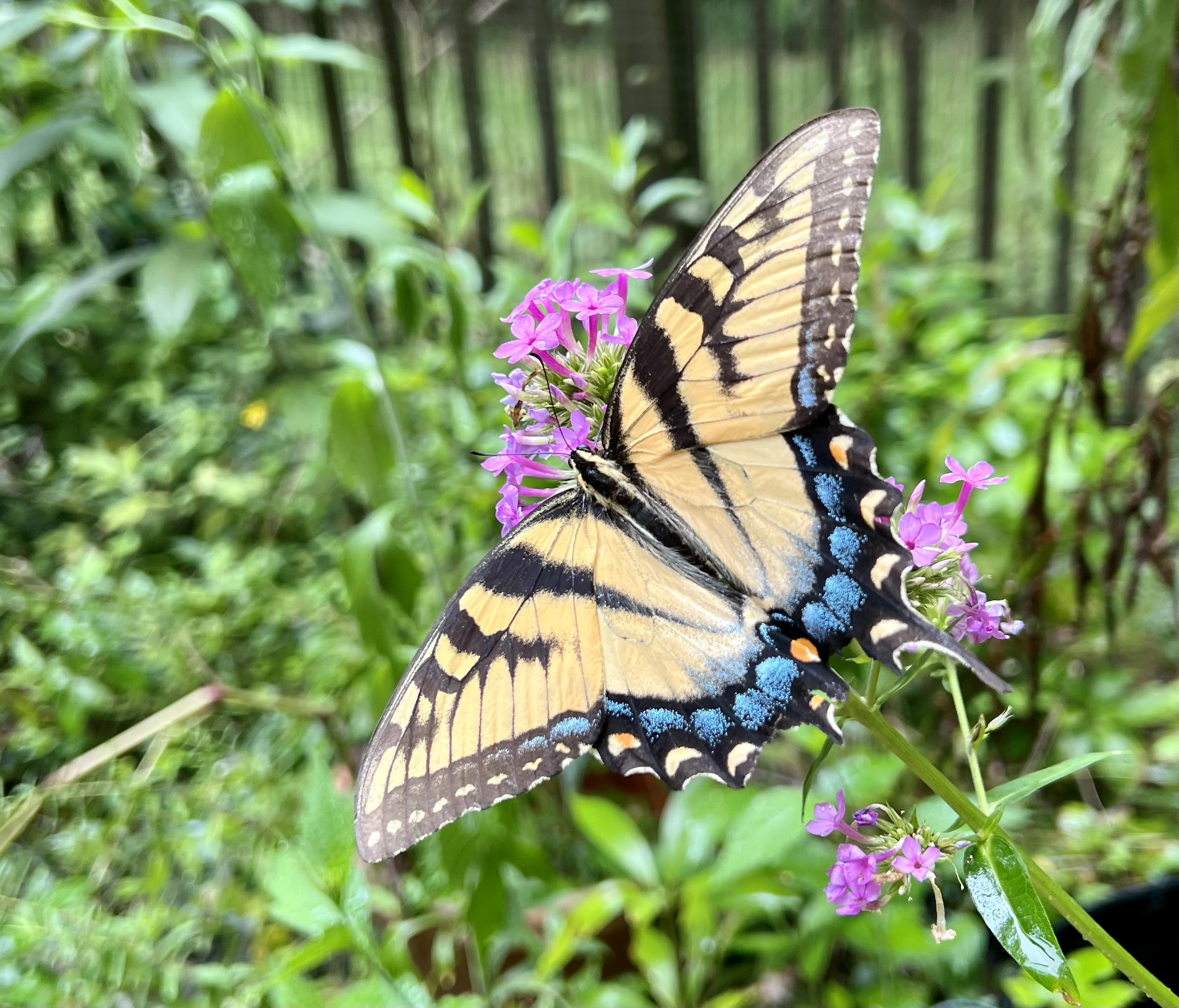
 The tigers have been a long time coming this year - the Eastern tiger swallowtail butterflies, that is. I have seen very few so far; even my neighbors' buttonbush failed to attract very many when it bloomed in June.

My summer phlox cultivar 'Jeana' (Phlox paniculata 'Jeana) is blooming now and a couple of females have been on it for days. I have written before about this especially floriferous cultivar (it has smaller flowers but more of them than the species). I also grow the Phlox paniculata species, so I have observed the differences first hand. Read my post (linked here) for the history of how this discovered sport came to be. Skeptical of cultivars? Read the native plant society's position on them here.

This month's #momentinnature celebrates these elegant butterflies and their return to my garden! Here's hoping that next year they'll come back a little sooner!


Sunday, July 16, 2023

Landscape Spotlight: Parking Lot Rain Garden


Last week I was driving with a friend when I spotted some cattails in a parking lot. About 1 second later I realized that next to the cattails were pink and white hibiscus, and I realized that someone had installed a rain garden there. The business currently located in this spot is Shake Shack, a burger/shake joint (this one is in Alpharetta).


Crimson-eyed rosemallow (Hibiscus moscheutos)


I have seen a couple of other efforts in the area to create parking lot drainage areas, but this one is particularly colorful. I’m not sure that the cattails (Typha latifolia) were a good idea because they are filling up the area and even popping up into adjacent areas. Particularly colorful right now were pink and white hibiscus (Hibiscus moscheutos). I was surprised also to see what appears to be wild bergamot (Monarda fistulosa); I had no idea it could handle the occasional heavy moisture that a rain garden can have. A blooming goldenrod (Solidago) was there as well but it might not have been planted deliberately.

Monarda 

Crimson-eyed rosemallow, different color form


Between the rain garden and the sidewalk, switchgrass (Panicum virgatum) was growing. The cultivars of that species are certainly helping it to get used in designed landscapes. And there are plenty of non-native plants in the overall design, but you can’t help but do a little fist pump to see things like this.