Sunday, February 26, 2017

Peeking in the Pocket

The Pocket at Pigeon Mountain (and the Shirley Miller Wildflower Trail located there) is a beautiful spring wildflower hotspot. A popular time to go is mid-March when flowers are very lush and colorful. I have been several times during that timeframe (you can read about my 2012 visit here), and I’m planning to go again this year with friends. Last weekend, in a spur of the moment decision, I decided to visit a month earlier than usual to get a peek at some of the super early wildflowers that won’t be blooming a month from now.

Erigenia bulbosa
Erigenia bulbosa next to Phacelia


The main attraction for this visit was to see harbinger of spring (Erigenia bulbosa), a tiny member of the Apiaceae (parsley) family. As you can tell by its common name, this is a very early wildflower. It was blooming nicely all along the trail and we were able to photograph it up close once the boardwalk transitioned to the dirt path that leads to the waterfall.

Hepatica nobilis var. acuta

Hepatica nobilis var. acuta

Hepatica nobilis var. acuta, purple flowers
The star of the day was sharp-lobed hepatica (Hepatica nobilis var. acuta or Anemone acutiloba). This perennial was scattered throughout the trail, growing in all conditions. Some of the clumps were huge, with numerous stems of flowers and old, leathery leaves (new leaves will emerge soon).

Most of the flowers were white, but in some areas we found purple ones - so that became the treat, to find them.


Hepatica nobilis var. acuta with small bee
I was also pleased to find a small carpenter bee (Ceratina sp.) exploring one of the hepatica flowers. The only other pollinator I found on that trip was a spring azure butterfly along the path to the parking lot.

The path to the waterfall had the most flowers. In addition to the two mentioned, we saw decumbent trilliums (Trillium decumbens) with buds, Virginia bluebells (Mertensia virginica) with pink buds (and one individual that was actually blooming but he was way ahead of his time), and a few blooming clumps of star chickweed (Stellaria pubera). We saw the early leaves of many of the March superstars too.

As we were returning along the boardwalk, we got another surprise. We met up with a couple visiting from Alabama that I know only from Facebook. What a happy coincidence that we picked the same day to visit and meet in person for the first time.

We also hiked the upper trail that leads to the top of the waterfall. There were not many flowers, but we found some of the purple-flowering hepatica and a single clump of bloodroot (Sanguinaria canadensis) on an exposed area (where perhaps it was getting extra warmth). We also saw the earliest flowering shrub – spicebush (Lindera benzoin) – just opening.

Bloodroot (Sanguinaria canadensis) attracting a few bugs too
Spring azure

I’m still looking forward to my March trip with some of my native wildflower-loving friends. I know the floral show will be spectacular and the company will be too.

Sunday, February 19, 2017

Plan for Butterflies

Tiger swallowtail on native azalea (April)
Even with our mild winters in Georgia, seeing that first butterfly is always a thrill. I usually always run back inside for my camera to record the event. It’s like a flower woke up and took flight!

You might think that butterflies just happen. The truth is, you have to plant for butterflies. Therefore, you need to plan for butterflies. The monarch butterfly’s troubles give us a good case for discussion because a large number of people are familiar with its reproductive needs.

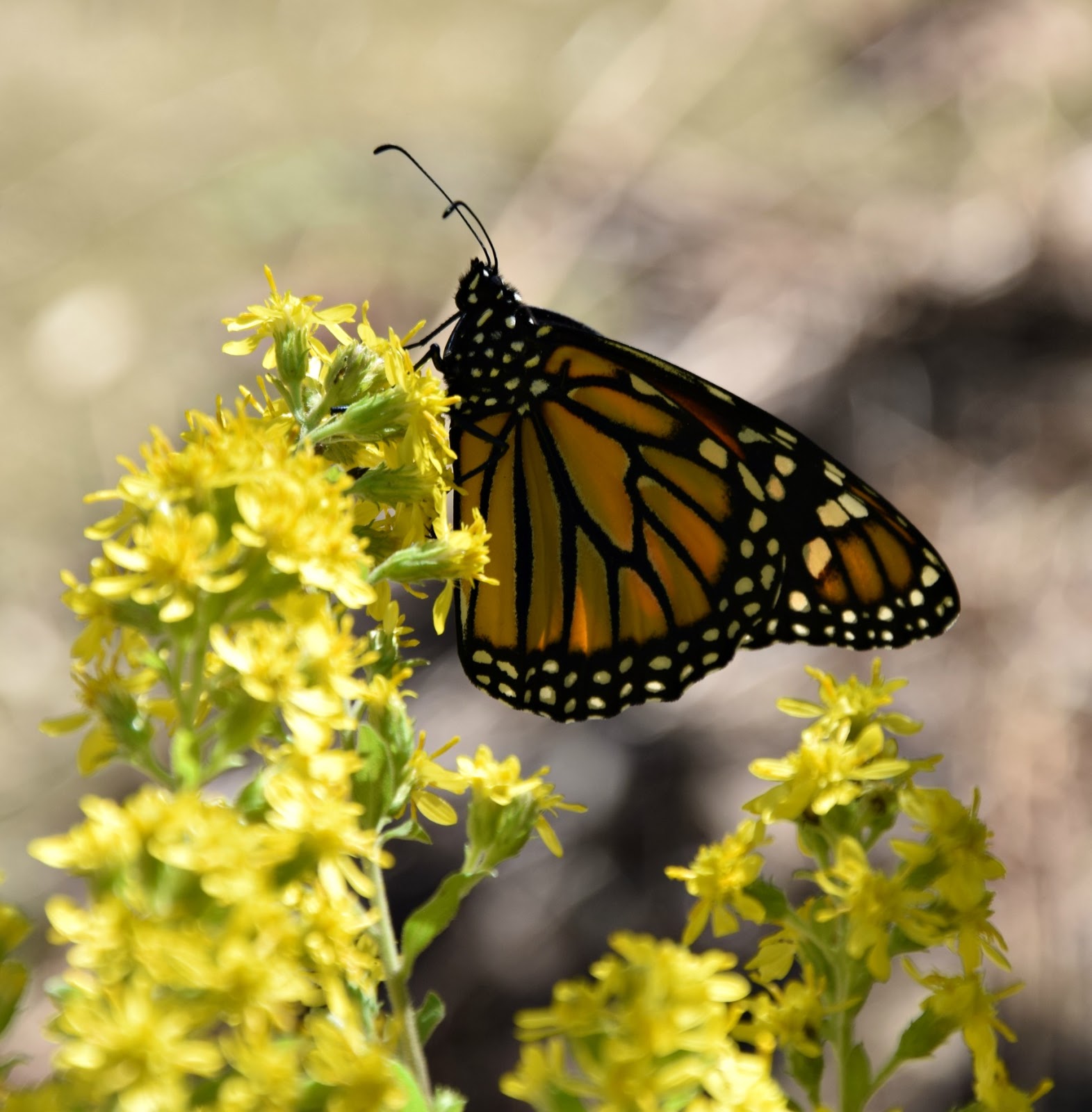
Monarch on goldenrod (great nectar plant)
Butterflies (and their more numerous relatives the moths) live out their cycle first as eggs and caterpillars and then become amazing flying machines. Caterpillars eat leaves and the adult females will only lay their eggs on just the right kind of plant. In the case of the monarch butterfly, that plant is milkweed (Asclepias sp.). If all the milkweed were to disappear, the monarch butterfly would become extinct. In fact, there are fewer monarches today in part because there is less milkweed in the wild than before.

Therefore, if you want butterflies, you need to provide the adults with plants on which they can lay their eggs. Lots of people plant butterfly gardens full of beautiful non-native flowers for them to feast on, but without sufficient host plants for the eggs, it’s like a nice cocktail bar … only there for adults. (For those of you adding parsley and fennel to your garden, that only supports 1-2 common butterfly species.)

How do you plan for butterflies? I take two approaches. First, I see what butterflies are already in my area by observing them in my yard or on my walks around the neighborhood and surrounding wild areas. For those butterflies, I want to make sure that I know what host plants they need and try to keep providing those plants in my yard.

American lady on pussytoes
Cloudless sulphur on partridge pea


Butterflies (and host plant examples) already around me include: Eastern tiger swallowtail (tuliptree, black cherry), red-spotted purple (black cherry, hawthorn), spicebush swallowtail (spicebush, sassafras), American lady (pussytoes, rabbit tobacco), buckeye (Ruellia, Agalinis), Gulf fritillary (passionvine), monarch (milkweed), and the many butterflies that host on plants in the pea family: cloudless sulphur and sleepy orange (partridge pea), long tailed-skipper (hogpeanut, Desmodium, silver-spotted skipper (false indigo), and Eastern tailed blue (Lespedeza).

Second, I research other common butterflies (or ones that other people near me mention) and work on adding to my yard the plants that they need for their caterpillars; the plants they need are native to my area but were probably culled out by humans before me. For example, the red admiral, comma, and question mark butterflies need false nettle (Boehmeria cylindrica) as a host plant, so I ordered some seeds for it. I recently added pipevine in the hopes of attracting a pipevine swallowtail. I have juniper but I’ve yet to see a Juniper hairstreak.

Red-banded hairstreak on Eupatorium
Sometimes new butterflies surprise me. In 2016, 4 new ones showed up: red-banded hairstreak, viceroy, gemmed satyr, and great spangled fritillary. Of those new ones, I don’t have host plants for the viceroy but I believe someone down the street has a willow (Salix). Willows are actually pretty common in wild wet areas but people don’t usually notice them. In my caterpillar searching, I found the caterpillar of the luna moth on sweetgum in the backyard, but I’ve not seen the adult.

It’s important to do your research and keep your eyes open. That’s one thing I learned during my caterpillar search last year; even if you don’t notice them, they’re out there. The more diverse selection of native plants that you have, the more butterflies you’ll have. Plan for it.

Sunday, February 12, 2017

As Lovely As a Tree

Liriodendron tulipifera
The third Friday in February is Georgia Arbor Day. It is a good day to plant a tree in Georgia because we generally have mild conditions and can usually dig a hole even in winter.

It is also a good day to remind ourselves why trees should be planted. This is a tuliptree (Liriodendron tulipifera). It provides food for several kinds of birds and small mammals. It is one of the host plants for the Eastern tiger swallowtail butterfly (state butterfly of Georgia). For humans, it provides shade, beauty, erosion control, and oxygen.


The title for this post references a poem by Joyce Kilmer entitled “Trees,” written in 1914. It's a wonderful poem for feeling good about trees. The well-known first couplet is:

I think that I shall never see
A poem lovely as a tree


The Arbor Day movement itself, of course, seeks to encourage people to plant more trees. The first Arbor Day in the United States was celebrated in 1872 by Sterling Morton in Nebraska. It was picked up nationally in 1907 thanks to a proclamation by Theodore Roosevelt with a focus on educating school children about conservation. Helping school children learn more about the importance of trees is a very fun and rewarding experience, but it’s never too late to learn about why having trees is so important.

American plum (Prunus americana) - host to over 450 different
butterflies and moths

Trees have nourished and inspired men for generations, every year enrapturing new people with their beauty, utility, or life-giving resources. I am proud to be a “tree-hugger” and seek to inspire others to love trees as well. I hope you will take this opportunity to consider the importance of trees to our ecosystem, especially native trees.

Here are some of my Arbor Day posts from previous years:

Arbor Day in Georgia

Plant a Tree for the Future

A Native Tree is Not Just a Tree

Sunday, February 5, 2017

Bird’s Eye View

American goldfinch
Sometimes we look at our yard from a neighbor’s perspective – is it neat and attractive? When you’re a nature lover, you might consider a different view point. How about from an insect’s perspective or a bird’s?

What are insects and birds looking for when they come by? We’ll have to imagine that we are such a creature, but it won’t take much imagination actually. We know that birds and insects need the essentials: food, water, shelter, and a place to raise their young. The important thing to understand that across the thousands of different types that pass through our yard, their needs vary quite a bit.

Food and Water

A low estimate of the number of bird species that pass through my yard would be 50. Some of them are frugivores, some are granivores, hummingbirds are nectivores, and then many of them are insectivores (or need insects for their chicks). They all don’t eat the same thing.

Ambush bug eats skipper
The number of insect species is even higher. Some of them are herbivores (eating plants: leaves, pollen, or nectar) while others are carnivores (eating other insects).

Within those two broad categories, insects are often specialists on certain plants (think monarch butterfly caterpillars eating milkweed, Asclepias sp.) or certain prey. For example, a small insect can eat a mosquito but it takes a larger one to eat a fly.

Tiger swallowtail nectars on Joe pye weed

In addition to birds and insects, of course, we also have lizards, turtles, and other critters and they have needs too. When you’re looking at your yard, do you have enough diversity to provide for the creatures that are thinking about living/eating there?

Shelter

Shelter needs are every bit as varied as food needs. There are the obvious bird considerations: nest boxes, dense shrubs, tall trees. Birds that are winter residents need thick vegetation during cold nights.

Critters need a place to go too when they are resting. They will hide out on all types of plants: leafy perennials, shrubs, and trees.

Insects will also take shelter in dead leaves, under loose bark, and in the soil. If a mowed lawn is our predominant vegetation, how helpful is that to insects?


Place to raise their young

Some critters actively manage their young (like birds) while others lay eggs and leave. Some (like bees) lay eggs with provisions and leave.

A spider has created an egg mass that will hatch after she dies
(the anole safely exited the web later)

Birds build nests in varied places: some nest on the ground, in brush, and in the cavities of dead and living trees. Eastern phoebes will make nests on manmade ledges (like my security lights). During active bird nesting season you can help by watching out for predators. We lost a whole nest of baby bluebirds because a snake got into the nest box and ate them. We now have a snake guard on that box.

A robin's nest in the open

So if you’re interested in attracting wildlife, look at your yard from a critter’s point of view. Maybe that tidy sweep of grass won’t look so good after all!

Some of my previous posts on supporting birds and insects:

Natural Bird Food
Native Shrubs for Birds
Black Cherry - A Perfect Plant for Birds
Native Birds Like Native Plants
Supporting Insect Herbivores
Everyday Nature

Sunday, January 29, 2017

Can I Get a G-E-O-R-G-I-A?

Several years ago I came up with an idea to create the picture shown here. It would spell Georgia and contain pictures of indigenous plants in each of the letters to show how beautiful and unique Georgia’s native plants can be. I finally came across a tutorial for my favorite picture editing software that explained how to do it. Thanks to James for enhancing it with a bold outline.


I decided to feature pictures in seasonal order (because I am all about being seasonal!) so the first plant listed is a spring bloomer and the last one listed is what you can find at the end of the year. Unfortunately, the hardest part was deciding which plants to use and limiting myself to seven pictures! Here are the picture contents:

G – early spring-blooming bloodroot (Sanguinaria canadensis)

E – mid-spring flowering eastern columbine (Aquilegia canadensis)

O – blueberries that ripen in June (Vaccinium sp.)

R – summer-blooming phlox (Phlox carolina) with syrphid fly

G – fall-blooming Georgia aster (Symphyotrichum georgianum) and Stone Mountain daisy (Helianthus porteri)

I – the fall foliage of chalk maple (Acer leucoderme)

A – the fruit of American holly (Ilex opaca)


I hope this graphic will help peak more interest in our beautiful Georgia flora. Feel free to share the picture!

Sunday, January 22, 2017

Hard Labor Creek State Park

Every year I try to visit more Georgia State Parks. I even bought an annual pass in 2016 to make it more economical, but I’m afraid that I let other things get in the way. During December I usually have extra vacation and try to convince others to go. This year I talked my daughter and husband into going to Hard Labor Creek State Park in Rutledge, GA, not far from I-20.

This is a large state park (5804 acres) and it contains walking trails, bike trails, and equestrian trails. You are allowed to walk on the equestrian trails so we planned to walk at least part of the Lake Rutledge trail (we did about 5 miles of the total 16). The park contains two lakes and Hard Labor Creek flows between them.

Before we had a chance to even find the trailhead, a flash of movement caught my eye in the parking lot. Rustling in the fallen hardwood leaves was an armadillo, searching for insects in the rich soil. I had always wanted to see one, so we took a few minutes to take his picture.

Our first creek crossing was a little tricky
Who you looking at?


The park is a beautiful deciduous forest in the Piedmont ecoregion, much like my own place. A study of the different fallen leaves during the hike found at least 6 oak species (white, red, southern red, post oak and likely both scarlet and black), several hickories, sourwood, several maples, musclewood, American beech, sweetgum, and American holly as well as numerous pines.


American beech (light tan) and chalk maple (dark tan)
This trail was a good place to see several good examples of marcescence, the characteristic of dead leaves remaining on the tree. The trees we saw with this characteristic were American beech (Fagus grandifolia), chalk maple (Acer leucoderme), and musclewood (Carpinus caroliniana) as well as several young oaks. In some places, there were large sweeps of each kind of tree adjoining each other, and each species had a slightly different shade of tan.

Christmas ferns sloping down to mountain laurel

Virginia sweetspire (Itea virginica)
In the area where the trail was beside Hard Labor Creek, steep slopes were populated with Christmas ferns (Polystichum acrostichoides) and thick stands of mountain laurel (Kalmia latifolia). I wanted to get to the creek but there was no way down. The trail flattened out where it reached the shore of Lake Rutledge and there we saw our second armadillo, diligently rooting through the leaves again. The shore area was populated with tag alder (Alnus serrulata) and Virginia sweetspire (Itea virginica).

Onward we went, following horse poop and hoof prints through the forest. I was happy to see lots of sparkleberry (Vaccinium arboreum) and the plants were still showing some great color. In some areas, the trees around were thick and overgrown.  We did pass one open area that was full of Indian woodoats (Chasmanthium latifolium), and I remembered that it can be aggressive but the seed heads were very attractive in such a group. Some of the evergreen plants we saw besides Christmas fern included ginger (Hexastylis arifolia), resurrection fern (Pleopeltis polypodioides) yuccas (Yucca filamentosa) were noticeable in the woods too.

Mistletoe (Phoradendron leucarpum) with fruit

After we finished our hike, we went into Rutledge for some ice cream at The Caboose. On our way back to I-20, we passed a parking lot full of old Bradford pears that were almost green with mistletoe (Phoradendron leucarpum). I swung the car into the lot and took some pictures since the plants were full of beautiful berries.

Sunday, January 15, 2017

The Seeds of Winter

Hibiscus coccineus
Before last week’s snow event, I walked around the yard to see what was happening in the garden. Most plants were brown, either dead above ground (herbaceous perennials) or dormant for the season (shrubs and trees). Even in these still-life poses, many offer up a promise of things to come: their seeds.

Most of these are non-fleshy seeds and they wait in their capsules or seedheads for one of the agents of dispersal to send them on their way: wind, water, and wildlife. I noticed that the capsules on the swamp hibiscus (Hibiscus coccineus) close up when wet and open wide when dry. Pine cones do this as well. I imagine they’ve evolved over time to adapt a strategy that works best for dispersal. The hibiscus seeds look like an offering of candy in a bowl, just waiting for a bird to come by and have a few.

Seeds attached to fluff on Liatris
Fluffy seeds of little bluestem


Some seedheads are puffy, each seed equipped with its own bit of fluff to carry it away. I think of these plants as hedging their bets: the puffiness alerts birds that the seeds are ripe and ready, but if the birds fall to notice them then the wind can be the means on which they travel. Some members of the Asteraceae family employ this technique but not all of them.

Hypericum densiflorum
Viburnum seeds may have to fall down
before being eaten.


The black-eyed Susans (Rudbeckia), rosinweeds (Silphium), sunflowers (Helianthus) and coneflowers (Echinacea) are three members of the Asteraceae family that keep their seeds tightly held in the dried flowerhead. If you’re cleaning seed, they are hard to get out! Birds are required to pry the tasty seeds out (and of course they are pretty good at it by now).

Helianthus, seeds on left already taken
Some stems come with bugs too

Turtlehead (Chelone glabra)


While I enjoy watching the birds at the bird feeder, I’m also happy to know that these seeds are available for them too. I do occasionally startle a pair of goldfinches feeding among the dry stems (never when I have the camera, of course).

Nature has been providing for them for thousands of years in this fashion, and I’m happy that my garden can contribute.