Sunday, March 27, 2022

Pollinators in Georgia: A Compilation of Articles

Support for pollinators (bees, butterflies, moths, wasps, flies, beetles, hummingbirds!) is higher than it’s ever been. Those of us who write in support of these critters (including the fabulous Heather Holm, check out her pollinator books on her Pollination Press website) are thrilled that more people want to help them at home, in our communities, and in our wild spaces. I have a lot of blog entries about pollinators, but I know it can be hard to find things. This blog post is a compilation of what I think are some of my best blogs to learn about pollinators and about how to support them in Georgia.
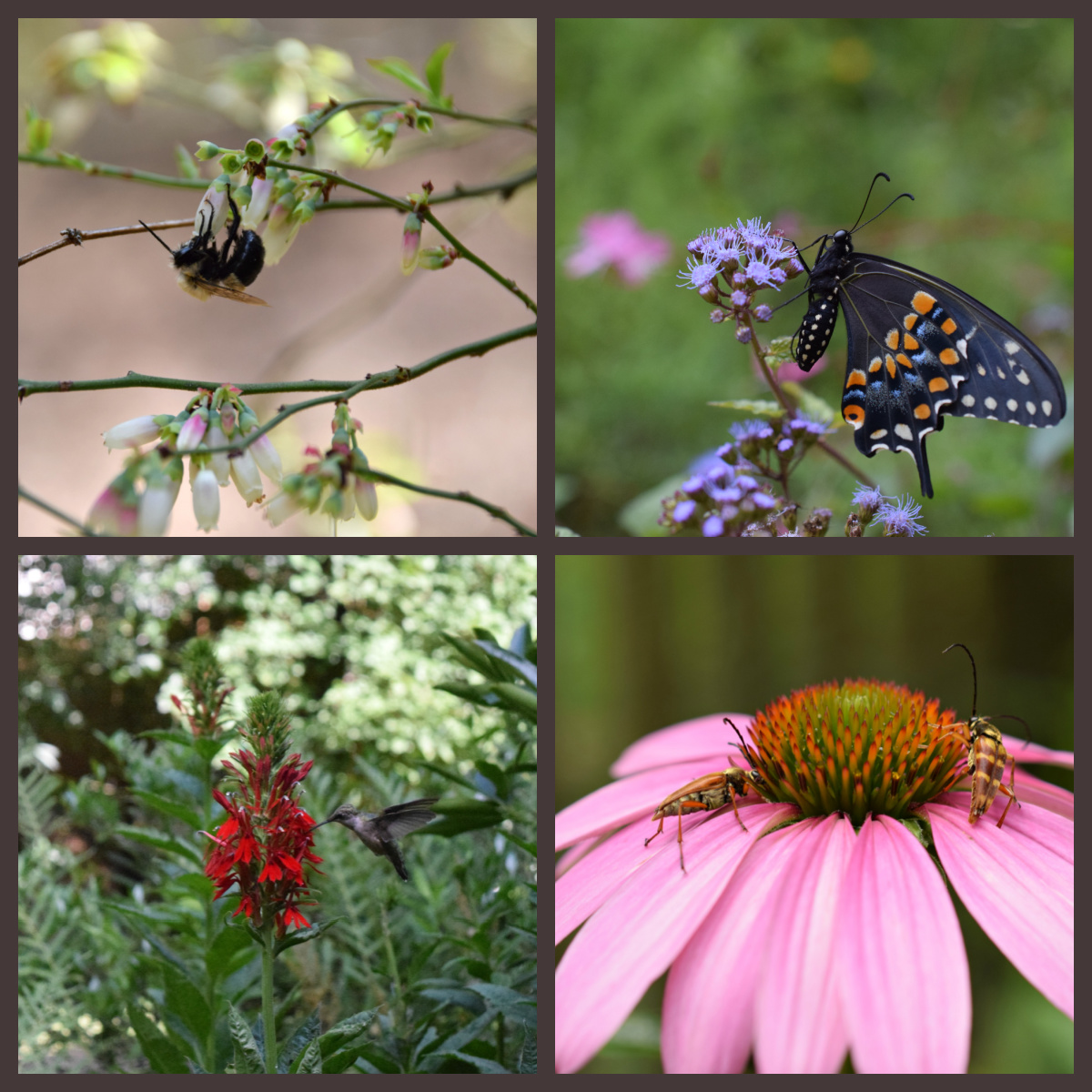

In Your Georgia Garden -general topics about helping your garden be a place of support for pollinators as well as topics on 3 specific butterflies in Georgia: Monarchs, Eastern Tiger Swallowtail, and the Pipevine Swallowtail.

Plan for Butterflies

Supporting Adult Butterflies

Garden for Life

Milkweeds in Georgia

Eastern Tiger Swallowtail - Georgia State Butterfly

Pipevine Swallowtail & The Shade Loving Host Plant

Fall Nectar Plants for Monarchs in Georgia

Why Native Plants Matter for Butterflies and Bees

Pollinator Gardening: Ideas and Tips - blogs with specific ideas, tips, and guidance on creating pollinator gardens.

Support Pollinators, Part 1 (Benefits and Basics)

Support Pollinators, Part 2 (Includes printable lists of plant ideas for 3 seasons)

Support Pollinators, Part 3 (Design Tips)

Gardening for Wildlife Simplified

Native Plants for Butterflies and Pollinators (includes printable lists, same as above)

Native Plants are the Real Thing for Pollinators

Supporting Birds - topics specific to supporting birds in your garden through the use of native plants.

Supporting Hummingbirds with Native Plants

Why Native Plants Matter for Birds

Native Birds Need 70% Native Plants

Native Birds Like Native Plants

Books/Resources - a few of the books I've reviewed about pollinators.

Gardening for Butterflies (Xerces book)

Pollinators of Native Plants (book)

Wasps (book)

Bee Welcome (book)

Sunday, March 20, 2022

Woodrushes: A Different Kind of Rush


Luzula acuminata, single flowers

When I first keyed out a streamside woodrush in my yard some years ago, I was surprised to realize how different it was in appearance to the rushes I’ve seen in wet areas or even in standing water. Woodrush (Luzula spp.) looks more grass-like than those aquatic rushes (Juncus spp.) and the flowers are arranged differently.

Recently I shared a photo of a pretty woodrush with a friend. After our discussion about it, I realized that I might actually have several different species because some grow in different areas and are noticeably taller than others.

In an earlier blog that I did about sedges (Carex spp.), I mentioned the rhyme for grasses, sedges, and rushes. Apparently these still follow the “rushes are round” when it comes to the stem and don't have the nodes/joints that distinguish true grasses.

The plants are flowering now and I have them in 3 places: they are abundant in the front lawn near the street; there is a single plant in the woods behind the house; and the largest area of woods is well-populated with a small form that loves to grow in moss.

Using a number of identification keys, photos on the internet, and herbarium records for my county, I have tried my best to figure out if these are 3 different species or two. There are 4 different species reported for my county.  

Solitary seeds forming on L. acuminata
Streamside Luzula (multiple flowers)


Since one plant has single flowers, it was easy to key that one out to hairy woodrush (Luzula acuminata) because it is the only species that does. Given my location, it is likely L. acuminata ssp. carolinae. That was the lone plant behind the house. From there, the remaining plants have multiple flowers and the identification points were a bit more subjective (is the inflorescence divergent, even widely spreading, or simply erect)?  

Clearly the last two have different growing habits and even the flowers seem slightly different when viewed with a hand lens. I take little pleasure in knowing that others have struggled to distinguish common woodrush (L. multiflora) from hedgehog woodrush (L. echinata) and sometimes they have been lumped together. In the end I have decided that the ones in the lawn are species L. echinata because of the more spreading inflorescence. The one in the woods, which is smaller in stature than the others, is still a mystery. Perhaps when the seeds develop, I’ll have another clue to consider.


Multiple flowers, L. echinata
Spreading inflorescence, L. echinata


Sunday, March 13, 2022

March 2022 Moment in Nature

I was outside last week (during that lovely but unusual warm spell) when I realized that a pair of woodpeckers were foraging just off the driveway. It was two pileated woodpeckers, likely a male and female, looking for bugs in decomposing logs.

I have a very natural area between the driveway and the area by the street. When small trees fall down, I am able to leave them in place to allow for all the natural processes to work on them. In the case of the woodpeckers, they are looking for beetle grubs and overwintering insects inside them.

I didn't get a picture of them, one had flown off by the time I came back with a camera. This picture is from last year. It was indeed a very special #amomentinnature to share my space with these birds. It is, after all, their space too.


After they left, I took a picture of the wood that they'd been exploring. This one is just about done hosting insects but it will continue to support decomposing insects as well as nourish plants.


Sunday, March 6, 2022

Foamflower Species Changes


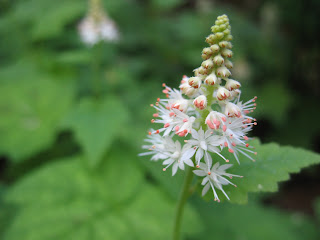
You never forget your first favorites. Foamflower was one of the first native plants that I learned as well as being an early favorite for its beautiful flowers and foliage. It is also very easy to grow and fairly available for purchase. Tiarella cordifolia was the scientific name that I learned. There is new information out there now to suggest that the plant I have in my area has a new name.

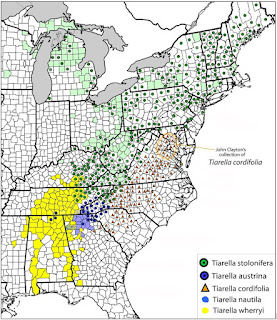
According to a new article by Guy Nesom: “Based on study of herbarium collections and foot-to-ground observations in 2021 in Alabama, Georgia, North Carolina, South Carolina, and Tennessee, I found that not one but five species of Tiarella are present in the eastern United States!” The map that he provides shows that the area where I live is exactly in a new species territory (Tiarella nautila):

Figure 1 from Guy Nesom's article

The article clearly presents the information on which the new species are based and I encourage you to read it. The following quote quickly gives you the basis for the separations:

“The main features distinguishing them are presence/absence of stolons, shape of the basal leaves, and presence/absence of leaves on the flowering stem. When the plants are sorted by these physical characters, the five entities are remarkably consistent in geography, showing sharp boundaries with very little overlap (Figures 1, 2).”

I went back through all of the pictures I've taken of foamflower - in the wild, in my garden, in other gardens - and looked for leaves on the flowering stems. Regarding the presence of stolons: only once in the last twenty years have I come across a plant with noticeable stolons. That was on a field trip to northeast Georgia (perhaps Rabun County). Based on photos in the linked paper (see the references in Nesom's article), this may be Tiarella stolonifera.

From NE Georgia, possibly Tiarella stolonifera

This photo from Sosebee Cove (NE GA) shows leaves on 
flowering stems so it is likely Tiarella nautila


This photo from The Pocket in NW Georgia shows no leaves
on flowering stems and leaves longer than wide, possibly Tiarella wherryi

Whichever one you have, foamflower is a wonderful native perennial and quite worthy of use in the shade and part-shade garden as well in restoration sites that have its habitat. Both the flowers and foliage are extremely attractive. Basal leaves often persist through the winter, offering a bit of winter interest.


NE GA, bracts on stems
NW GA (Cloudland), tiny leaf

Sunday, February 27, 2022

Stop and Give Me 70


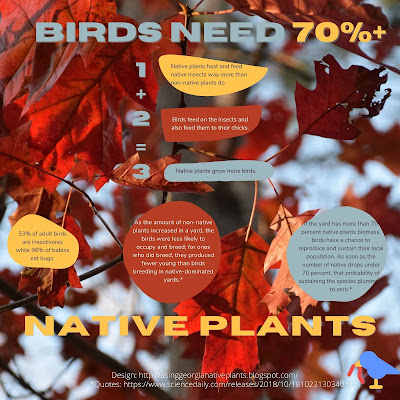
Seventy percent, that is, and actually more would be better. If you know this blog, you already know that I’m talking about native plants. People often ask how many native plants or what percentage should they have. A study by Doug Tallamy and his team* found that at least 70% was required and that even higher numbers are needed to keep bird populations from declining.


The following quote is from the linked article: “As the amount of non-native plants increased in a yard, the birds were less likely to occupy and breed; for ones who did breed, they produced fewer young than birds breeding in native-dominated yards.”

If you’d like to have birds in your yard, or if you’d like to support birds in general, having keystone native plants and a diversity of them is important. Here is a list of keystone plants; you may already have some.

Don’t feel like this is an unreachable number or a huge task. If you have native oak and maple trees in your yard, they are likely contributing in a big way to your total biomass. The number one opportunity for improvement is usually reducing the lawn. My early January post gave some ideas for working through this bit by bit.

This quote from the Science Daily article that I linked in the first paragraph is particularly insightful:

"The important lesson is that use of non-native plants in landscaping has a 'trickle-up' effect," said Doug Levey, a biological sciences program director at NSF. "Those attractive, non-native plants just provide less food at the base of the food chain and thus support fewer birds than native plants."

We can help ensure that birds have a home in our landscapes for years to come if we plant native plants more often and in greater abundance. So put back those begonias, grab some Coreopsis, milkweed, and purple coneflower (take out a section of lawn if you need to). Swap out some of the knock-out roses for winterberry holly (Ilex verticillata) or crape myrtle for serviceberry (Amelanchier) and let's get to 70%.

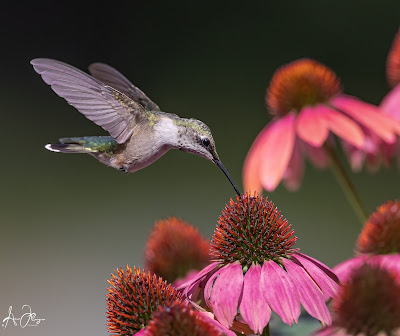
Hummingbird on purple coneflower by Gena Flanigen


* Study details: Narango, Desirée L., Douglas W. Tallamy, and Peter P. Marra. Desirée. 2018. Nonnative plants reduce population growth of an insectivorous bird. Proceedings of the National Academy of Sciences of the United States of America.

Sunday, February 20, 2022

Georgia Arbor Day


Serviceberry

Georgia Arbor Day comes the third Friday in February because it’s a good time for Georgians to plant trees. If you didn’t plant a tree this week, however, you still have some time. I would say that good conditions for tree planting in Georgia - cool and moist conditions - continue into March.

When it comes to choosing plants for your yard, especially plants that make a positive impact on your local ecosystem, a native tree offers a lot of benefits over a non-native one. Research has shown that woody plants like oaks and maples support more insects in their life cycle than perennials. 

Let’s consider two choices: a native serviceberry (Amelanchier) vs. a non-native crape myrtle (Lagerstroemia). According to data compiled by Doug Tallamy and his team, serviceberry can support 119 species of butterfies/moths while crape myrtle supports just 3. If you had a small yard and wanted to help grow more butterflies/moths then which would you plant? If you wanted to support birds, the serviceberry wins in two ways: it has tasty fruit that birds adore and it grows caterpillars for them to eat too.

I’ve written about Arbor Day quite a few times over the years. As a tree lover, it’s a topic that never gets old. When my kids were in elementary school, I enjoyed helping the students there celebrate. In my post from 2012, I shared some of those experiences. In my post from 2013, I encouraged people to plant for the future and shared Joyce Kilmer’s lovely tree poem.

In my post from 2015, I expanded on why using a native tree over a non-native tree provided more benefit to the local ecosystem. My post from 2018 provided a list of my tree profiles over the years to help people learn more about some specific trees. It was truly a celebration of trees.

If you’ve already got enough native trees, plop a chair under them and start dreaming about your perennial garden (because, yes, we need perennials too!).

Sunday, February 13, 2022

February 2022 Moment in Nature

Winter months are not just a time to bemoan the lack of green leaves. I like to use the time to appreciate some of the other aspects of plants: the branching structure, the distinctive appearance of leaf buds, the dried stems and seeds of herbaceous perennials.

For this month's #amomentinnature, I stopped to take a photo of a large oak tree in the back corner of an old cemetery.


In a time where old trees aren't saved as often as they should be, I am grateful to places like old cemeteries where they can rest in peace.