Sunday, December 26, 2021

2021 in Pictures

I take a lot of pictures throughout the year and not all of them make it into a blog post. At the end of the calendar year, it’s a good time to reflect on the beauty of nature as well as share some of the extra pictures. I believe that each day is an opportunity to find and appreciate something beautiful in the native plants and creatures of Georgia.


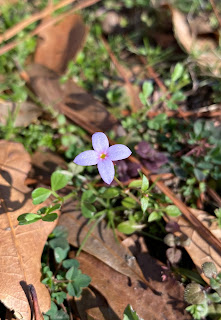
Georgia’s winter weather can be mild at times so spotting an early flower like this annual Houstonia pusilla might be unusual but not impossible. It is, of course, always welcome to get an early flower. Then February came along with some really cold days such that the tub of water that I was accidentally keeping had an inch of ice on it! My grandson enjoyed busting it up.


Houston pusilla
Inch-thick ice in February


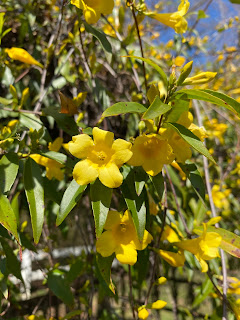
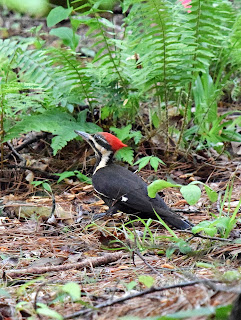
March is a good flower month for us; this is my neighbor’s arbor of Carolina jessamine (Gelsemium sempervirens) looking pretty awesome. In April, one of our resident pileated woodpeckers enjoyed looking for bugs in fallen logs on our property.

Gelsemsium sempervirens
Pileated woodpecker


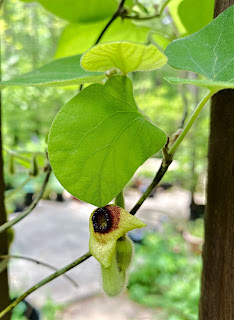
Aristolochia tomentosa

I was thrilled in May to find that my pipevine (Aristolochia tomentosa) was blooming for the first time on my fence. The plant has been there for about 4 years if you’re wondering how long it takes to bloom. The butterflies laid eggs on it 2 or 3 times and we successfully raised a bunch of them, a number of which are overwintering in chrysalis.

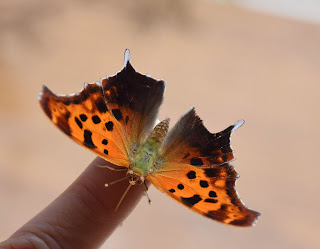
Speaking of butterflies, this Question Mark butterfly showed up in June and I loved the way the sunlight made it glow. This one can overwinter as an adult, but I think this one was probably a fresh one; we have plenty of its host plants in the area: elm, hackberry, and nettles.


Question  mark butterfly


Spring peeper frog

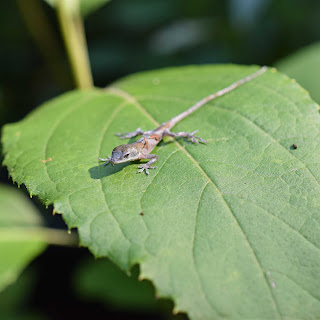
This tiny frog showed up in July and it is one that I’ve never seen before in my area: a spring peeper. I’ll add that to my growing list of identified amphibians that I’ve found here. I’ve found plenty of reptiles too! A young Carolina anole was shedding its skin in August as it hopped through the dense vegetation of summer looking for tiny bugs. 

Carolina anole


This Jamesianthus alabamensis finally bloomed in September. Its common name is Alabama warbonnet and I found it at Plant Life Nursery in Rome. They were growing it from seed that they’d gotten from a customer. Some of our small nurseries really do grow some unique things. You can search this blog for some of my small nursery profiles.

Jamesianthus alabamensis
Late monarch


In mid-October I released the last of about 8 monarch butterflies that I raised. A friend nearby had gotten some caterpillars on her plants and she shared some with me. It was an unusual late summer season in the Atlanta metro area for monarchs, with many folks reporting them later than usual as they passed through Georgia. This one paused before flight on a Eastern silver aster (Symphyotrichum concolor).

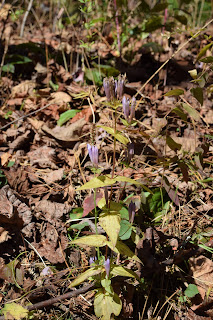
This Gentianella quinquefolia is a bit past peak flowering, but it was a new find for me so I get to celebrate finding in November on a hike in North Georgia. I’ll have to go back earlier next year to see it again.

Gentianella quinquefolia
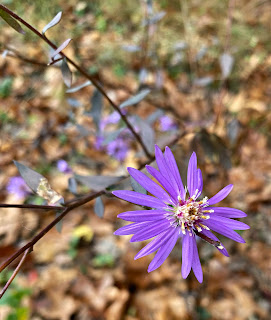
A mystery Symphyotrichum


I end the year with a mystery which has me looking forward to 2022. This pretty aster was still blooming in mid-December in north Fulton County. I posted photos of it to the Southeastern Flora group on Facebook. Based on feedback there and my own research, it might be Curtis’s aster (Symphyotrichum retroflexum). I’m going to try and collect seeds and see if we can better figure this out.

Wishing you a good year in 2022 and more native plants and critters in your daily life.

Sunday, December 19, 2021

George L. Smith State Park


On our way back from Florida this past week, I convinced my husband to depart from I-16 to visit George L. Smith State Park in Emanuel County. This 1634-acre park has a 412-acre lake that was the mill pond for the historic Parrish Mill. It includes a few walking trails and you might even find a gopher tortoise (Georgia’s state reptile) or see a indigo snake. Much of the draw for this state park is the lake where folks enjoy paddling and fishing.


Trees stretched on and on
Pond cypress (Taxodium ascendens)


We did not come prepared to paddle, so we walked around the lake shores a bit, admiring the blackwater and the beauty of the trees reflected in it: pond cypress (Taxodium ascendens), bald cypress (Taxodium distichum), and swamp tupelo (Nyssa biflora). We saw several kinds of native fruits: ogeechee lime fruits (Nyssa ogeche) were floating in the water near the mill while a swamp tupelo (Nyssa biflora) was heavy with fruit. 

Nyssa biflora fruit
Nyssa ogeche fruit


Evergreen plants provided good botanical interest: sweetbay magnolia (Magnolia virginiana), Carolina cherry laurel (Prunus caroliniana), and wax myrtle (Morella spp.) were in several areas. According to a botanical inventory shared with me by Bobby Hattaway, there are actually 3 species of wax myrtle in the park: cerifera, caroliniensis, and pumila.

Cyrilla racemiflora provides color
Vaccinium arboreum


We also saw plenty of tardily deciduous plants showing a bit of color: swamp titi (Cyrilla racemiflora) and sparkleberry (Vaccinium arboreum) both had a nice mix of colorful leaves, while horse sugar (Symplocos tinctoria) had the occasional purple leaf and water oak (Quercus nigra) was a mix of green, yellow, and brown.

I look forward to coming back during spring or summer to see more plants, especially when they are in flower.

Sunday, December 12, 2021

A Moment in Nature for December

I started this monthly #amomentinnature feature in January of this year and I have enjoyed doing it. Taking the time to recognize small moments for their fleeting beauty or uniqueness is a habit worth cultivating. The moment in January featured morning light so it seems fitting that the last month of the year appreciates afternoon light.


As the afternoon sun angled down towards the horizon, the reddish leaves of oakleaf hydrangea (Hydrangea quercifolia) were absolutely aglow this week. 

I often say that if you plant this shrub just for its fall color, you'll get your satisfaction out of it. The rest of the seasons are just a bonus.

So get out there and find your moments. And share them with others. We all need  #amomentinnature from time to time.

Sunday, December 5, 2021

Nature-Inspired Gift Ideas

There’s no getting around it, it’s the gift-giving season. Each year it seems to get a bit more challenging as we get older and everyone has enough candles and tchotchkes (but never enough fudge). Toss in concepts like buy more made-in-America products, support small businesses, and go easy on the environment and what’s a girl to do?! 

Well, I do have some ideas for the gardener or nature enthusiast on your list. [At right are some of the gifts my friends have given me.]

Plants are always popular with gardeners and divisions from your garden make memorable gifts. Pair it with a durable plant tag complete with Latin and common names and on the reverse put your name and the date. Buy a set of metal labels, use one, and give them the extras too.

Garden signs (like the one above) make nice gifts, can be very personal, and never die for lack of water. Find dozens of hand-crafted ideas on places like Etsy or get inspired to make your own. You can even find signs that illustrate your friend’s garden is pesticide free.

Gift memberships to organizations such as the Georgia Native Plant Society, the Georgia Botanical Society, Georgia Audubon, The Xerces Society, The Nature Conservancy, Georgia State Parks Annual Pass, and many others help your friend get more involved. Most of these groups have tangible benefits such as monthly, quarterly, and annual publications in addition to supporting their mission. Get them a t-shirt to wrap up with your gift announcement. 

Those same organizations accept donations in honor of your recipient. Other organizations that you might consider include Georgia DNR (tell them it is for the non-game division to support plant conservation), the Trust for Public Land, the Georgia Piedmont Land Trust, Southern Conservation Trust, the Georgia Conservancy, Chattahoochee Riverkeeper, and many more local groups. Get them a tote bag or coffee mug to commemorate the gift.

Some of those same organizations also have online stores to purchase gifts. You can also purchase gifts and memberships to local nature centers and museums. The Caterpillar Lab is one of my favorite places for not just beautiful and unique gifts but ones which are also supportive of their mission.

Books still make fantastic gifts and there are some great nature-focused ones out there. For the beginner native plant enthusiast, one of Doug Tallamy’s books would be inspiring. The more experienced gardener might appreciate learning more about identifying pollinators, or give a child a book that celebrates native plants. My most recent read was Saving the Wild South.


Photo Source

Of course money is always good and gift certificates for small nurseries (pick the Georgia nurseries labeled ‘primarily native’ at this site) will illustrate that you took the time to find a great place to get lovingly grown and local plants (really appreciated by nature lovers!). Wrap up your gift with brown craft paper and decorate it with leaves, pine cones, drawings, or other natural materials tied up with fabric ribbon or twine.

Gifts of time are especially appreciated by older folks who need help in the garden or just appreciate your company. Create your own gift certificate with messages like “Will plant your new plants for you or Weed your garden” and package it up with a few tea sachets and a message that you can enjoy a cup of tea together after the work is done.

I hope that some of these ideas work for you. If you have other, nature-related ideas, please share them in the comments! 


Sunday, November 28, 2021

Saving the Wild South (the book)


Inspirational nature writing doesn’t come nearly as often as we need it, but there’s a new book out now that is excellent for folks in the Southeast. It is a book rich with research, yet engaging to the average plant-minded citizen, plus a dip into the lives of some of the people who champion plant and habitat conservation. 

I thoroughly enjoyed author Georgann Eubanks’s profiles of 12 plants across 10 chapters; these chapters don’t just inform but they seek to help raise our awareness and appreciation of efforts to conserve plants and habitat in the South.


Yadkin River goldenrod (Solidago plumosa) and Heller’s blazingstar (Liatris helleri) is the first chapter and it starts with botanizing in late 1891 in NC with J.K. Small and A.A. Heller. This story hooked me from the start with the feel of being there followed by the present-day efforts of folks like Alan Weakley, who found the goldenrod again in 1994.

Florida Torreya (Torreya taxifolia) was discovered by an amateur botanist in 1833, overharvested and then attacked by a blight perhaps brought over on imported plants. The chapter focuses on the efforts of a local group, the Torreya Keepers, and conservation organizations such as Atlanta Botanical Garden (ABG) that are growing more plants and installing them in protected areas. Learning about folks that are so passionate and dedicated to a specific plant was inspirational and heart-warming.

Alabama canebrake pitcher plant (Sarracenia alabamensis) and green pitcher plant (Sarracenia oreophila) – this chapter includes fascinating details on these very unique plants, bringing a new appreciation for some of our special native plants. Here again, the interviews with passionate young people, ABG, and Nature Conservancy staff provide both hope and reality in the story of protecting and propagating these plants.

Miccosuke gooseberry (Ribes echinellum) is a prickly shrub that is clinging to its existence after surviving thousands of years. In this chapter, history once again provides the backdrop to the plant’s story, a most appealing combination to me. I was surprised to realize that I have seen this plant myself, on a 2013 trip with the Georgia Botanical Society to Stevens Creek Heritage Preserve. I certainly don’t remember realizing what a special plant it was (but then those trips tend to have so much to discover).

Miccosuke gooseberry (Ribes echinellum) 

Shoals spider lily (Hymenocallis coronaria) or Cahaba Lily has a passionate group of folks looking out for it in South Carolina, Georgia, and especially Alabama. I grow the related Hymenocallis occidentalis, one that is happy to grow in soil, unlike the Shoals species that needs flowing water.

Morefield’s Leather flower (Clematis morefieldii) discovered relatively recently in 1982, one of many special native Clematis that are being classified more recently. My favorite part of this chapter was learning how new plant locations were found by creating “a spatially explicit predictive map of possible sites.” The people involved in conservation are amazing!

Michaux’s sumac (Rhus michauxii) is a story that I’ve read about before because it is one based in Georgia, but the efforts of dedicated folks to make a difference for this plant is worth reading in more detail. Mincy Moffett of Georgia DNR and Jenny Cruse-Sanders of ABG were part of a team to bring two disjunctive populations together: females from Newton County and males in Elbert County. According to this article, there has been some success (fruit!). The chapter also includes some details on the Georgia Plant Conservation Alliance (GPCA).

River cane (Arundinaria gigantea) was a chapter where I learned a lot – such as how widespread it used to be (acres and acres of it!), how much it was used by indigenous peoples, as well as how very important it is to its native ecosystems. It clearly should be used more in conservation efforts.

Schweinitz’s sunflower (Helianthus schweinitzii) is a plant that I’ve heard about from my NC native plant friends. This story highlights the importance of "restoring and maintaining open grasslands, meadows, and savannas" even at the county level, demonstrating that it’s not just federal and state level efforts that matter.

American chaffseed (Schwalbea americana) is a loner that I had never heard of. The only species in its genus, this prairie perennial also depends on open habitats. This chapter was a perfect one to showcase the efforts of Dwayne Estes, The Prairie Preacher, and his work with the Southeastern Grasslands Initiative (SGI). Many plants are waiting to be rediscovered (or discovered) as we better understand what was here before we arrived.

I hope these little summaries whet your appetite to read this book. It is a well-written mix of plant specifics, history, and profiles of dedicated people. The extensive research is reflected in the bibliography by chapter in the back.  I enjoyed reading about some of the folks whose names I’ve heard for many years. The book covers people and plants throughout NC, GA, SC, AL, FL, and TN. I also like the way she weaves topics from one chapter into the others, a bit of a reminder of how interconnected the ecosystem is.

The thoughtful Epilogue at the end is worth reading too. It includes some additional conversation quotes that she didn’t use in the book. Page 221-22 has a list of ways that ordinary folks can help. The Acknowledgement section includes a bit about how she chose the plants to include. It's all good!


Sunday, November 21, 2021

Rhus copallinum – A Name to Remember

Double nerd alert! I have a few passions in my life, one of which is native plants, as you know. Another is grammar and that includes understanding parts of speech and usage (don’t forget to spell your family’s name right on your holiday cards). So I was thrilled to learn something new about words this week when I asked about the species name for winged sumac.

A little background on why I asked: over the years I have developed a little memory trick for myself to help remember how to spell species names in the same genus. Please note that I never took Latin in school (although botanical Latin is quite not the same) but I have vaguely learned that species endings have something to do with gender of the genus and generally match others in the same genus. I’ll use cherry (Prunus) for an example. Black cherry (Prunus serotina) is the one that I remember the best but sometimes I forget if Chickasaw plum is Prunus angustifolius or Prunus angustifolia. So I think back to black cherry and remember it ends in an ‘a’ and therefore it must be Prunus angustifolia.


Winged sumac (Rhus copallinum)

I noticed this week that winged sumac (Rhus copallinum) does not agree with its relatives -- smooth sumac (Rhus glabra) and staghorn sumac (Rhus typhina) -- or it would be “copallina.” I asked why and got the reply that “Copallinum is a non-declinable noun” and to check Weakley 2020 for more details. In that document I found “The Linnaean epithet "Copallinum" (traditionally capitalized) is grammatically a noun in apposition rather than an adjective, and therefore does not change grammatical gender.” A noun in apposition? Off I went to research that.

This is a good source to understand that a noun in apposition is one that further describes the noun but which of course is still a noun itself. Indeclinable nouns are those that don't display grammatical relations with other words in a sentence by means of declension. What we normally have is an adjective that must agree in gender with the generic name (e.g., glabra which means smooth). In searching Weakley 2020, that description is mentioned 5 times; the other four are Nabalus serpentaria, Packera millefolium, Smallanthus uvedalia, and Orbexilum lupinellus.

So this is one that we must just memorize (and I’ll likely not forget it now). If you’d like to know the meaning of the noun copallinum, according to this source: “copallinum means "gum copal" and refers to the resemblance of the dried sap to that of the copal tree.” Several other sources indicate that it is related to the word copalli which means gummy or resinous.

If you’d like to read more about our native sumac species, check out my earlier blog: Sumac – Roadside’s Rowdy Rhus.


Sunday, November 14, 2021

Vogel State Park – A Place for Fall Color


Lake Trahlyta at Vogel State Park

Fall color in North Georgia is much sought after when it comes to this time of year. Scores of people drive up to get a glimpse of mountainsides decorated with red, gold, orange, and green quilts of color. The photo at left is from the drive on US-19/US-129 near Neel Gap.

When a friend posted on Facebook about his trip to Vogel State Park, I decided quickly to schedule a visit this past week while the weather was good and the leaves were still on the trees.

I had never been to Vogel State Park before but have visited lots of places near it around Blairsville, Suches, and Dahlonega. I had heard that it is a great place for fall color and once I saw Lake Trahlyta I could see why. The long lake provides an excellent reflection of the trees on the mountains.

Red maple (Acer rubrum)

The park is the second oldest Georgia state park, established in 1931. From the park’s website, “Located at 2500 feet above sea level, Vogel sits at the base of Blood Mountain, the highest summit on the Appalachian Trail in Georgia, and is surrounded by Chattahoochee National Forest. The North Georgia Mountains around Vogel were linked to Native American people for generations before European settlement.” On our way there, we stopped briefly at Neels Gap and admired the trees in the parking lot festooned with old hiking boots, a tradition for those who finish the Appalachian Trail.

Vogel has a number of well-marked trails of various lengths and difficulties. We opted for the shortest and easiest, the Trahlyta Lake Trail and the spur to Trahlyta Falls. The color was fantastic, the trail was easy, and a few floral goodies were found as well. I was thrilled to find a large witch hazel (Hamamelis virginiana) in full bloom, the fresh flowers juxtaposed nicely with the crispy leaves. I also found a flower that I had never seen, stiff gentian or Gentianella quinquefolia.


Awesome maple in the parking lot 

Trahlyta Falls 


American witch hazel (Hamamelis virginiana) in bloom

If you’d like to read about my other visits to Georgia State Parks, here is a list of them. Each one is special in its own way and season, and several make for excellent winter visits, especially when waterfalls are involved.

Red Top Mountain State Park

FDR State Park – Winter and Spring

Hard Labor Creek State Park

Cloudland Canyon State Park

High Falls State Park

Chattahoochee Bend State Park

Providence Canyon State Park

Tallulah Gorge State Park

And if you'd like to add more fall color to your landscape using native plants, here is a blog I wrote about plants with Dependable Fall Color.