Sunday, May 11, 2014

Awesome, Easy, Native Perennials for Georgia Gardens


This week is an outstanding week for blooming spring perennials. I was standing there admiring the cheerful collection of blooms on my mouse-eared coreopsis (Coreopsis auriculata) and I thought “Wow, more people should have this plant!” Then I took two steps and noticed the clouds of purple blooms on the beardtongue (Penstemon smallii) and thought the same thing.

Mouse-eared coreopsis (Coreopsis auriculata)

Come to think of it, there are a lot of very dependable native perennials that you might consider using. As always, take these as suggestions and do your own research as to availability, site suitability and native range for your area.  These are plants that I personally have found to be tolerant of a variety of conditions, forgiving in times of forgetfulness, and able to rebound after problems (like deer munching).

Penstemon smallii


So here are a few of my favorite ones that are particularly awesome and easy. It’s a surprisingly big list when you consider all the seasons.


Spring: foamflower (Tiarella cordifolia), Solomon’s plume (Maianthemum racemosum) and our evergreen gingers (Hexastylis) are real standouts in part shade. Showier spring flowers include red columbine (Aquilegia canadensis), beardtongue (Penstemon) and tickseed (Coreopsis). Most people have great success with blooming groundcovers like the native creeping phlox (Phlox subulata) and green ‘n’ gold (Chrysogonum virginianum).

Aquilegia canadensis

Rudbeckia hirta with spider and bee


Summer: Black-eyed Susan (Rudbeckia hirta) and its orange coneflower relatives (R. fulgida), annual red salvia (Salvia coccinea), butterfly milkweed (Asclepias tuberosa), pale bergamot (Monarda fistulosa), mountain mints (Pycnanthemum), wild quinine (Parthenium integrifolium) and spiderwort (Tradescantia). Shade tolerant superstars are black cohosh (Actaea racemosa) and fly poison (Amianthium muscitoxicum).

Mountain mints (Pycnanthemum) are pollinator magnets!


Georgia aster (Symphyotrichum georgianum)

Fall: sunflowers (Helianthus), clump-forming goldenrods (Solidago), blazing stars (Liatris), thoroughworts (Eupatorium), and asters (Symphyotrichum). The blues, whites and yellows of fall flowers make for amazing combinations.

The late fall flowers of Helianthus angustifolius

Need more suggestions? Check out my other posts about spring and summer perennials (where for some reason I put beardtongue in the summer category). Hmm, I didn’t make a fall one? I need to add that to my list of things to do. I do have some posts on specific fall perennials like Helianthus, goldenrod (Solidago), and asters (Symphyotrichum).

Note: my perspective is from the Piedmont area of Georgia (Atlanta area). You can find some information about Coastal Plain plants on the publications area of the website for the Georgia Native Plant Society. Or search this website using the term Coastal Plain.

Sunday, May 4, 2014

Black Cherry Butterflies


Butterfly gardening is a popular topic. Private and public gardens love to create butterfly gardens, artfully arranging combinations of parsley, fennel, milkweed and flowering nectar plants. Parsley and fennel are two well-known garden host plants for butterflies and of course milkweed for monarch butterflies is a hot topic these days.

A newly emerged red-spotted purple (Limenitis arthemis)

Yet not far from these butterfly gardens is a plant that supports far more butterflies and moths than those 3 plants combined. It is a plant that is overlooked, under appreciated and downright disparaged at times. Meet black cherry, Prunus serotina.

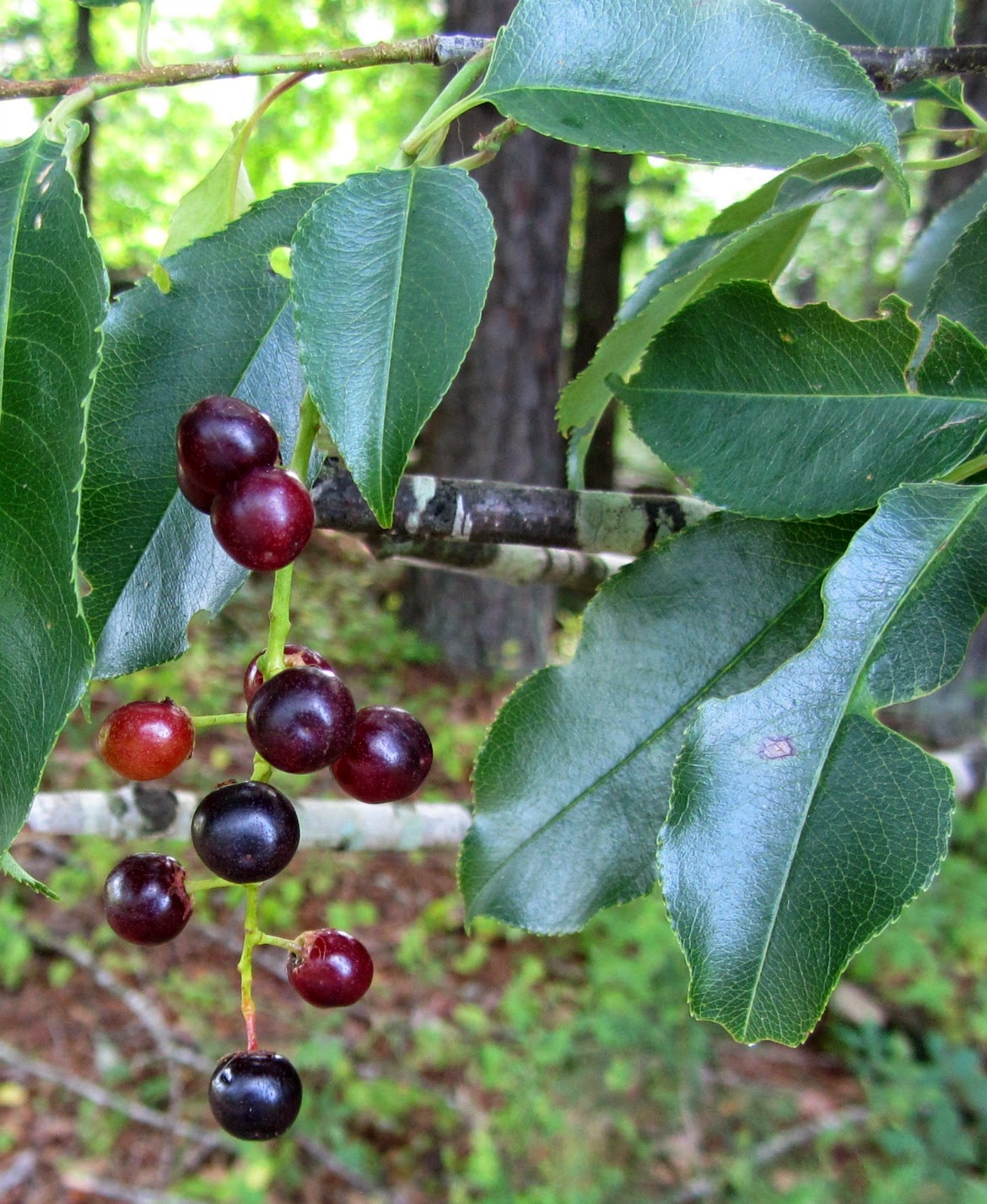
Black cherry is native throughout Georgia, from the mountains to the coastal plain. It is considered a medium sized tree although it can reach a height of almost 100 feet in ideal conditions. It blooms in April - long drooping racemes of creamy white flowers that are popular with native bees and other early pollinators. Pollinated flowers become clusters of red-black fruit that are eaten by birds (and even humans).

April flowers of Prunus serotina

Ripening fruit and caterpillar-chewed leaves

According to research by Doug Tallamy and his team, the Prunus genus supports at least 456 different species of Lepidoptera (butterflies and moths). Native cherry trees like the black cherry are host plants for Eastern Tiger Swallowtails, Red-spotted purples, Cecropia moths, Coral and Striped Hairstreaks, White Admirals and many others.

You might already have it in your yard. Look around for it.

Furcula caterpillar (with fungus) on Prunus serotina


How do parsley, fennel and milkweed stack up against black cherry? Both parsley and fennel are in the Apiaceae family which supports less than 50 native Lepidoptera species in the whole family (across all genera in that family).  Milkweed (Asclepias) supports about 12.


So there you have it, 456 species for Prunus compared to 50 for parsley/fennel and 12 for milkweed. No disrespect to the monarch and other butterflies, but how many butterflies do you want to support?  Make sure that a black cherry is not far from your butterfly garden and your impact will be exponentially better than without it.


Sunday, April 27, 2014

Carnivorous Plants in Okefenokee


When I signed up for the 2014 Wildflower Pilgrimage to the Okefenokee Swamp, I did it partly because I was interested in seeing pitcherplants, a type of carnivorous plant. I did not expect to see so many other types – including plants with cute names like butterworts, bladderworts, and sundews.

Do I look carnivorous? (Pinguicula lutea)
This is part 3 of my trip with the Georgia Botanical Society in late March 2014. You can read about part 1 and part 2 by clicking on the hot links.

Here is a bit of general information on carnivorous plants that I learned. First, the nutrition these plants get from insects is only part of their intake of nutrients. Second, these plants tend to grow in nutrient-poor soils that don’t provide enough nitrogen (such as in boggy places like swamps). Third, insects are trapped or gathered through the use of modified leaves, not with their flower.


Drosera capillaris  with flower stalk emerging
Tiny, sparkling red sundews (Drosera capillaris) grow on roadsides near the swamp. We saw them on several roadside field trips, nickel- to quarter-sized plants tucked in between other low-growing vegetation. We unwittingly tromped all over them in search of more showy flowering plants, but once we discovered them we were thoroughly charmed.

Snagged a bug?
In the types of carnivorous plants, sundews are known as “sticky flypaper” plants. The leaves contain both nectar and adhesive compounds to attract and retain prey. Digestive enzymes are there as well to process the catch. These plants do flower as well but we were too early for that.

We saw three kinds of butterwort on our roadside trips: the yellow butterwort (Pinguicula lutea) , the blue one (P. caerulea), and the dwarf one (P. pumila).

Pinguicula caerulea

The butterworts were all in flower and I did not realize at first that they were a type of carnivorous plant. The flowers were held high above the sticky leaves that formed a rosette on the ground.

Pinguicula foliage


As another type of sticky flypaper plant, the leaves are poised to capture small insects via tiny hairs which are covered in sticky mucilage. Once prey is caught, the leaf edge rolls inward to complete the process but never completely closes.


The terrestrial Utricularia subulata
We found bladderworts (a type of bladder trap) both on land and in the water. The tiny yellow Utricularia subulata was on the wet roadsides.  I can only imagine the tiny bugs that must be snagged by its bladder-like traps when the soil is saturated. I expect we would need a microscope to see them.

The aquatic bladderworts like Utricularia inflata were in the swamp and in the ditches, their bright yellow flowers like a flag on a ship (or at least on a bobbing life raft). The wheel-like arrangement of this bladderwort show some of the tiny bladder structures but there are more below. The bladders have tiny hairs attached to them that small creatures bump into. According to botany.org, “When they are stimulated, these hairs cause the flattened bladder to suddenly inflate, sucking in water and the passing animal and closing a trap door after it.”

Utricularia inflata

Finally we get to the pitcherplants (Sarracenia sp.) a type of carnivorous plants known as "pitfall traps." On land, we saw a few plants that were not yet flowering: parrot pitcherplant (S. psittacina ) and hooded pitcherplant (S. minor). Once we got into the swamp on a canoe, we were able to see the flowering yellow pitcherplant (S. flava). The flowers and tall pitchers were dramatically beautiful. The modified leaves that form the pitcher contain a bit of nectar to attract insects and then an illuminated funnel to trick the insect into thinking that going further into the funnel is the way out.

Sarracenia flava

Bottom line: plants are interesting. Like us, they have evolved over many years to adapt and thrive in the conditions that they have. Eating bugs to supplement their diet is just one of many ways. Cool stuff!