Sunday, January 29, 2017

Can I Get a G-E-O-R-G-I-A?

Several years ago I came up with an idea to create the picture shown here. It would spell Georgia and contain pictures of indigenous plants in each of the letters to show how beautiful and unique Georgia’s native plants can be. I finally came across a tutorial for my favorite picture editing software that explained how to do it. Thanks to James for enhancing it with a bold outline.


I decided to feature pictures in seasonal order (because I am all about being seasonal!) so the first plant listed is a spring bloomer and the last one listed is what you can find at the end of the year. Unfortunately, the hardest part was deciding which plants to use and limiting myself to seven pictures! Here are the picture contents:

G – early spring-blooming bloodroot (Sanguinaria canadensis)

E – mid-spring flowering eastern columbine (Aquilegia canadensis)

O – blueberries that ripen in June (Vaccinium sp.)

R – summer-blooming phlox (Phlox carolina) with syrphid fly

G – fall-blooming Georgia aster (Symphyotrichum georgianum) and Stone Mountain daisy (Helianthus porteri)

I – the fall foliage of chalk maple (Acer leucoderme)

A – the fruit of American holly (Ilex opaca)


I hope this graphic will help peak more interest in our beautiful Georgia flora. Feel free to share the picture!

Sunday, January 22, 2017

Hard Labor Creek State Park

Every year I try to visit more Georgia State Parks. I even bought an annual pass in 2016 to make it more economical, but I’m afraid that I let other things get in the way. During December I usually have extra vacation and try to convince others to go. This year I talked my daughter and husband into going to Hard Labor Creek State Park in Rutledge, GA, not far from I-20.

This is a large state park (5804 acres) and it contains walking trails, bike trails, and equestrian trails. You are allowed to walk on the equestrian trails so we planned to walk at least part of the Lake Rutledge trail (we did about 5 miles of the total 16). The park contains two lakes and Hard Labor Creek flows between them.

Before we had a chance to even find the trailhead, a flash of movement caught my eye in the parking lot. Rustling in the fallen hardwood leaves was an armadillo, searching for insects in the rich soil. I had always wanted to see one, so we took a few minutes to take his picture.

Our first creek crossing was a little tricky
Who you looking at?


The park is a beautiful deciduous forest in the Piedmont ecoregion, much like my own place. A study of the different fallen leaves during the hike found at least 6 oak species (white, red, southern red, post oak and likely both scarlet and black), several hickories, sourwood, several maples, musclewood, American beech, sweetgum, and American holly as well as numerous pines.


American beech (light tan) and chalk maple (dark tan)
This trail was a good place to see several good examples of marcescence, the characteristic of dead leaves remaining on the tree. The trees we saw with this characteristic were American beech (Fagus grandifolia), chalk maple (Acer leucoderme), and musclewood (Carpinus caroliniana) as well as several young oaks. In some places, there were large sweeps of each kind of tree adjoining each other, and each species had a slightly different shade of tan.

Christmas ferns sloping down to mountain laurel

Virginia sweetspire (Itea virginica)
In the area where the trail was beside Hard Labor Creek, steep slopes were populated with Christmas ferns (Polystichum acrostichoides) and thick stands of mountain laurel (Kalmia latifolia). I wanted to get to the creek but there was no way down. The trail flattened out where it reached the shore of Lake Rutledge and there we saw our second armadillo, diligently rooting through the leaves again. The shore area was populated with tag alder (Alnus serrulata) and Virginia sweetspire (Itea virginica).

Onward we went, following horse poop and hoof prints through the forest. I was happy to see lots of sparkleberry (Vaccinium arboreum) and the plants were still showing some great color. In some areas, the trees around were thick and overgrown.  We did pass one open area that was full of Indian woodoats (Chasmanthium latifolium), and I remembered that it can be aggressive but the seed heads were very attractive in such a group. Some of the evergreen plants we saw besides Christmas fern included ginger (Hexastylis arifolia), resurrection fern (Pleopeltis polypodioides) yuccas (Yucca filamentosa) were noticeable in the woods too.

Mistletoe (Phoradendron leucarpum) with fruit

After we finished our hike, we went into Rutledge for some ice cream at The Caboose. On our way back to I-20, we passed a parking lot full of old Bradford pears that were almost green with mistletoe (Phoradendron leucarpum). I swung the car into the lot and took some pictures since the plants were full of beautiful berries.

Sunday, January 15, 2017

The Seeds of Winter

Hibiscus coccineus
Before last week’s snow event, I walked around the yard to see what was happening in the garden. Most plants were brown, either dead above ground (herbaceous perennials) or dormant for the season (shrubs and trees). Even in these still-life poses, many offer up a promise of things to come: their seeds.

Most of these are non-fleshy seeds and they wait in their capsules or seedheads for one of the agents of dispersal to send them on their way: wind, water, and wildlife. I noticed that the capsules on the swamp hibiscus (Hibiscus coccineus) close up when wet and open wide when dry. Pine cones do this as well. I imagine they’ve evolved over time to adapt a strategy that works best for dispersal. The hibiscus seeds look like an offering of candy in a bowl, just waiting for a bird to come by and have a few.

Seeds attached to fluff on Liatris
Fluffy seeds of little bluestem


Some seedheads are puffy, each seed equipped with its own bit of fluff to carry it away. I think of these plants as hedging their bets: the puffiness alerts birds that the seeds are ripe and ready, but if the birds fall to notice them then the wind can be the means on which they travel. Some members of the Asteraceae family employ this technique but not all of them.

Hypericum densiflorum
Viburnum seeds may have to fall down
before being eaten.


The black-eyed Susans (Rudbeckia), rosinweeds (Silphium), sunflowers (Helianthus) and coneflowers (Echinacea) are three members of the Asteraceae family that keep their seeds tightly held in the dried flowerhead. If you’re cleaning seed, they are hard to get out! Birds are required to pry the tasty seeds out (and of course they are pretty good at it by now).

Helianthus, seeds on left already taken
Some stems come with bugs too

Turtlehead (Chelone glabra)


While I enjoy watching the birds at the bird feeder, I’m also happy to know that these seeds are available for them too. I do occasionally startle a pair of goldfinches feeding among the dry stems (never when I have the camera, of course).

Nature has been providing for them for thousands of years in this fashion, and I’m happy that my garden can contribute.

Sunday, January 8, 2017

Resolutions 2.0

Often we make resolutions for ourselves at the start of each New Year: lose weight, drink less soda, take vitamins more often, eat more fresh vegetables …. We all have these, right? I was reading an essay (“Ecosystems at Our Doorsteps”) in The Xerces Society Wings magazine (Fall 2016 edition) and it occurred to me – we should make some resolutions that benefit the other critters on Earth. So here’s my take on some improved resolutions; let’s call it Resolutions 2.0.

Male bumblebee

We have the power to make a difference in our own yard (back and front!). The choices that we make can help or harm all that live in this area: bees, butterflies, birds and even other humans.

Are we using pesticides that harm insects or lawn chemicals that affect any animal that walks across the grass? Are we polluting the air with fumes and noise from leaf blowers (when we could be burning calories by raking and sweeping)? Are we providing good sources of pollen, nectar and fruit/seeds?


So be it resolved:


  1. I will protect pollinators by not using pesticides in the yard. Bees will be free to gather pollen and nectar that has not been altered by pesticides like neonicotinoids and others. In addition, other bugs will be safe from unintended harm caused by spraying of pesticides designed for one bug (such as mosquito treatments) but which kill others too.
  2. I will be aware that bees and other insects need a place to live. Many bees are solitary and nest in the ground (need some bare patches) or in wood like tree bark and dead branches/trees. I will use this awareness to leave room for nesting. I will be aware that butterflies and moths need a place to pupate – in a chrysalis or a cocoon or even over the winter in dead leaves.
  3. I will allow the balance of nature to control pests such as other insects or birds that eat them. I may choose to selectively deter pests by spraying them with water from the hose or hand-picking bugs like Japanese beetles and dropping them into a bucket of non-toxic but lethal soapy water.
Blue mistflower (Conoclinium coelestinum) is always a winner in the fall; common checkered skipper agrees

  1. I will plant flowers with abundant pollen and nectar for insects. I can use three lists that I put together in 2014 for spring, summer, and fall. These lists will give me plenty of ideas of what to add to my garden for this goal.
  2. I must remember to buy them from places that didn’t treat them with pesticides while they were growing them.
  3. I can plant with wildlife in mind. When choosing what plants should be in my yard (either as new or as replacements for non-native plants), I can be more aware of what benefits each plant brings to the greater ecosystem (not what just brings me pretty flowers).
The work of small bees on this butterfly milkweed (Asclepias tuberosa) resulted in many seed pods

  1. Butterfly gardening is more than colorful flowers. I can choose plants that provide multiple benefits: not just floral rewards (nectar and pollen) but those which also are host plants. For example, milkweed (Asclepias) is a great nectar plant (my bees love it) but it is also a host plant for butterflies such as the monarch. If you have a small garden, learning about plants that support both roles means you can do more with a smaller space.
  2. I can increase my overall plant diversity to help more insects. There are hundreds of butterflies, thousands of native bees, and even more thousands of native moths and many of them have special plant relationships. Without their special plant being available, the insect cannot remain in that area. There’s no value to planting the same thing as everyone else and planting large groups of the same thing.
  3. I can look for regionally appropriate plants to make sure local insects get the support they need. For example, while I love Florida anise (Illicium floridanum), its native range is nowhere near me; it is native to the southeast Coastal Plain where Georgia adjoins Florida. Therefore, I recognize that having it in my landscape is not much different than having a plant from another country.

New plant this year, downy wood mint (Blephilia ciliata),
popular with bees
Amorpha fruticosa fed many caterpillars
this year

Sunday, January 1, 2017

2016 in Pictures

I take a lot of pictures throughout the year and not all of them make it into a blog post. At the end of the calendar year, it’s a good time to reflect on the beauty of nature as well as share some of the extra pictures.

I believe that each day is an opportunity to find and appreciate something beautiful in the native plants and creatures of Georgia.


In January of this year, we got a little snow and I was able to practice using the macro lens that I got in 2015 on some snowflakes. I think I can still improve, so I hope to be able to have another go in 2017.


Brown-headed nuthatch


February can be another month with little plant action so camera shots continue to focus on other things like birds (brown-headed nuthatch on snag near driveway at left) and the beauty of raindrops (above right, the stripes are a reflection of the fence behind it).


I was visiting a friend’s large property in March when I got a chance to see something really unusual – an owl pellet. It is the remains of one or more meals and contains the indigestible parts (bones, as you can see, fur, and other things). The pellet is regurgitated not passed as feces.


Owl pellet

Goldfinches are fast little birds and I don’t often get to see one up close. I see them feeding on my seedheads but they are quick to leave when the camera gets too close. I had a seed bag up in April and was able to catch a picture of this beautiful male.


Goldfinch
Bumblebee on Styrax americanus


May is a busy bee time and, as I look through my pictures, that is when I start to have a lot of them. An American styrax (Styrax americanus) that I purchased recently was very popular with bees. I sure look forward to seeing the bees come out each year, each species carefully attuned to arrive when pollen and nectar are available for them.

I was gone for half of June this year, exploring the Wild West with my daughter. It was fun to see new flora (and fauna!) and to see relatives of species that we have in Georgia.

Butterflies have a long season in Georgia (I just saw an orange Sulphur the other day!) but July was a particularly fantastic month and I saw two new-to-me butterflies in the yard. I wrote about the Viceroy in July while extolling the pollinator feast on devil's walking stick (Aralia spinosa). The other new butterfly was a Great Spangled Fritillary that was very fond of a native thistle (Cirsium).

Great Spangled Fritillary
Blue dasher dragonfly

Thanks in part to my neighbor’s pond, dragonflies are always around in my yard. I have seen 6-7 species over time (probably more if I could discern some of the finer details), but this species (Pachydiplax longipennis) is always particularly abundant (and friendly). This picture of a male is from August.

Surprises in my garden are delightful and this September found me swooning over the blooms of (Agalinis purpurea). I had gathered some seeds from a wild area adjacent to a shopping center (what some might call a “waste” area!) and thrown them into the sunny bed last year. If you read my Summer Greens post in August then you certainly can understand how I might have overlooked a couple of new plants hiding in the midst. This genus needs to have some native grasses nearby (it is hemiparasitic on the roots of grasses), so it luckily found what it needed here. I hope it sprouts again there in 2017.
Agalinis purpurea
Virginia creeper fruit
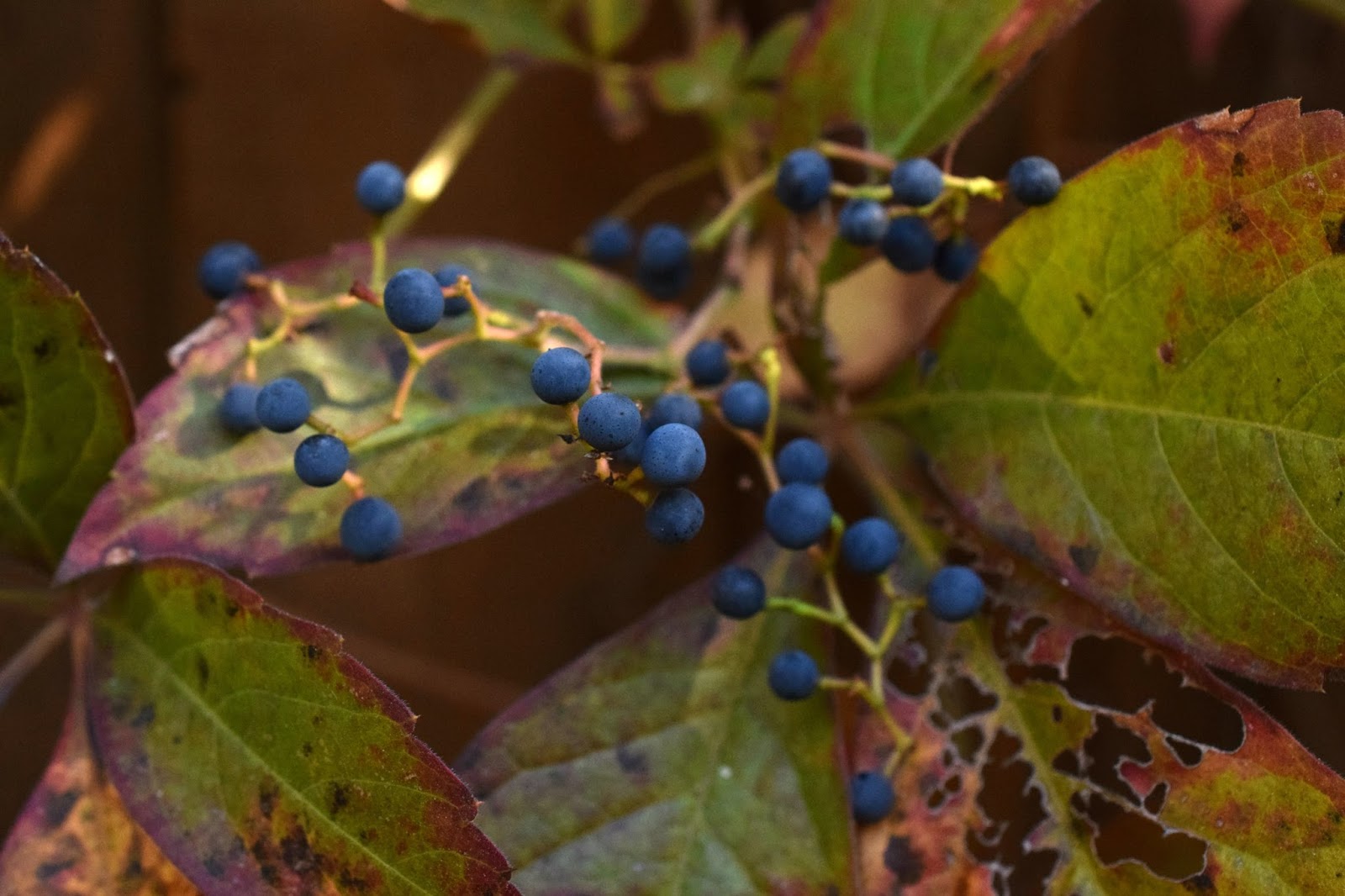
Another success story showed up in October – my Virginia creeper (Parthenocissus quinquefolia) flowered and bore fruit after years of climbing up the side of the house to the second story deck. 

Not many people would cheer about having more Virginia creeper, but I grow it for the birds and the caterpillars that use its foliage. I do regularly pull some of the vines off the house (they come off easily) but this one got to stay long enough to do its thing.

Gentiana saponaria
I have blue gentian (Gentiana saponaria) naturally on the property but the deer browse them. I put some rescued gentians inside my pool fence this year and they flowered in November. Their bright blue flowers were a surprise and a delight almost hiding under a robust group of heart-leaved asters. Yes, things get a bit crowded inside the fence!

A trip to Williamsburg in December had me checking out the natural decorations along Duke of Gloucester street. You can see a post about the native plant materials used in some of them in this blog post from a late winter visit in 2014. The decorations can vary from year to year, and this year I found a beautiful wreath with dried sunflower heads (Helianthus) and sumac fruits (Rhus).


I wish you a Happy New Year, full of beautiful and productive encounters with our native wonders.

P.S. The log featuring the "2016" was a longtime snag (5+ years) next to my driveway that finally fell this year. It helped me get a number of great bird shots over the last few years, including the one in February above.

Sunday, December 25, 2016

Jolly Holly

Possumhaw (Ilex decidua)
Hollies are one of the most used plants for winter decorations such as Christmas. The most familiar species are the evergreen ones that have bright red berries such as American holly (Ilex opaca). In Georgia, this species is widely distributed throughout the state and makes a fine landscape tree.

Hybrids of American holly are used in landscaping more often than the plain species; Ilex x attenuata cultivars are crosses between Ilex opaca and the southern dahoon holly, Ilex cassine. Hybrids such as ‘Savannah,’ 'East Palatka,’ and ‘Fosteri’ are robust female plants with heavy fruit set (and fewer spines on the leaves) that require little to no cross-pollination. Some of these hybrids were found in the wild as natural crosses.

American holly (Ilex opaca)

Yaupon holly (Ilex vomitoria)
Yaupon holly (Ilex vomitoria) is an evergreen holly that is also often used, even outside of its natural range in the Coastal Plain. It is popular for several reasons. It has small, spineless evergreen leaves. It grows well in landscaped areas throughout the state. Several dwarf forms are suitable as small shrubs such as around home foundations (where they are sheared into meatball shapes but I think they look great when left unpruned as well). Female plants, which are not usually the dwarf forms, have tiny red fruits that have a bit of a translucent look, quite different from of the opaque berries of American holly.

Georgia has two other evergreen hollies located in the Coastal Plain: dahoon holly (Ilex cassine) and myrtle holly (Ilex myrtifolia). Both have red fruits.

Red-fruited hollies are not always evergreen. Georgia has at least 6 species of deciduous hollies, all of which have red fruits. The leafless winter stems of these species can be spectacular and the horticultural world has noticed. Cultivars of both possumhaw (Ilex decidua) and winterberry (Ilex verticillata) are available in the trade. When choosing, be sure to determine if you’re buying a male or a female and that you have compatible males and females eventually (you can have more females than males).

Ilex verticillata
Ilex decidua


The remaining deciduous native hollies in Georgia include two in the Coastal Plain (Ilex amelanchier and Ilex ambigua) and two in the northern part of the state (Ilex montana and Ilex longipes).

Ilex glabra
Evergreen hollies don’t always have red fruits. There are several species that have dark blue fruits. The two species in Georgia are large (or sweet) gallberry (Ilex coriacea) and the smaller one known as inkberry (Ilex glabra). Both like to grow in moist areas. Inkberry can be found in the nursery trade and is available in forms that are dwarf and compact; look for ‘Shamrock,’ ‘Compacta,’ ‘Nigra,’ and ‘Densa’ and carefully check for male/female suitability if you want berries (the ones listed are noted as females while ‘Nordic’ and ‘Pretty Boy’ are male).

Native hollies are great additions to the home landscape. They are beautiful, adaptable and important to wildlife. The small but numerous flowers are important to native bees. Gallberry honey, which is produced by European honey bees, comes from nectar gathered from Ilex coriacea and Ilex glabra. All the berries are popular with birds that eat fruit. Consider adding a regionally appropriate holly to your landscape next year.

Sunday, December 18, 2016

Atlas of Georgia Brings Herbaria to the People

Please note: this website (Atlas of Georgia Plants) is no longer online. For a similar tool, please see my blog about the SERNEC Portal.

When I find plants that are new to me, I do try to identify them. I use a variety of tools, including books and online resources. Many times, after an initial investigation, I might be in the position of comparing 2-3 species in order to reach what I think is the final identification. Identifying asters in the fall is such a case. Pictures can be very helpful at this point, but pictures on the web don’t always have the appropriate details or, even worse, might be misidentified by the person that posted them.

Choose Browse or Search Collection here
A new tool came online this year and I’m pretty excited about it. The Atlas of Georgia Plants portal is a means of viewing vouchered herbarium specimens from the University of Georgia and Valdosta State University herbaria. Over 100,000 specimens, some dating back to the 1800s, have been digitized and are now available for online viewing with more to come.


You can browse the collection by Family, by Genus, and by County. From the navigation menu, choose “Browse Collection” to get started. Some collections are quite large and some are quite small. Some counties have very large numbers of specimens. The same is true for certain plant species. Having a large selection of specimens gives you more to examine which is good; some are in better shape than others. Detail varies by specimen; some of them include roots, most flowering perennials that I checked do include the flowers.
The General Info tab of a selection

Most people might find it more efficient to use the search capability. From the navigation menu, choose “Search Collection” to enter your search criteria such as Genus and Species (e.g., Quercus for genus and coccinea for species). 

This screen has a nice feature: as you type, the webpage is finding matches for you. For example, after having typed “coc” in the species field, you have seven choices already and can choose “coccinea” from the list. You can refine your list by adding county as well.


Image sheet with zoom capability


Once you have found a specimen that you want to examine, double-click on it to open it. This opens the “general info” tab. To see the specimen, click on “image sheet” in the secondary menu. Once you’re in the image sheet, you can zoom in on the specimen if you first choose the option “Switch to interactive view” at the bottom of the page.  Go back to the “Static view” when you are done. 

When you are ready to close the specimen, close it from the top menu by x’ing the specimen number (this is an 1895 specimen of scarlet oak collected by James Small, numbered as “GA084077”). You can keep multiple specimens open at once; just click “Search Collection” again to get another one without closing this one.

Note that some are marked “poisoned.” This means that they were treated against pests.


You can see distribution information at the bottom of the species page (before you select a specimen). In addition, you can find pictorial depictions of distributions at this linkThis link has Alphabetical letters for plant families (e.g., choose “F” to go to Fagaceae if you want to search for Quercus (oaks) or “C” for Caprifoliaceae for Lonicera (honeysuckle)). From there, choose the species you want to go to the distribution maps. I like the list of county names so that I can quickly check which counties have presence rather than trying to figure out the counties by staring at their shapes on a map.

I compared the distribution map to the USDA distribution for chalkbark maple (Acer leucoderme); there are a few differences at the county level but the general distribution is the same (herbarium records might be driving USDA maps, I am not sure).


In general, this is another tool in our kits for identification. If you're in Georgia or nearby states, you might give it a try and see what you think.